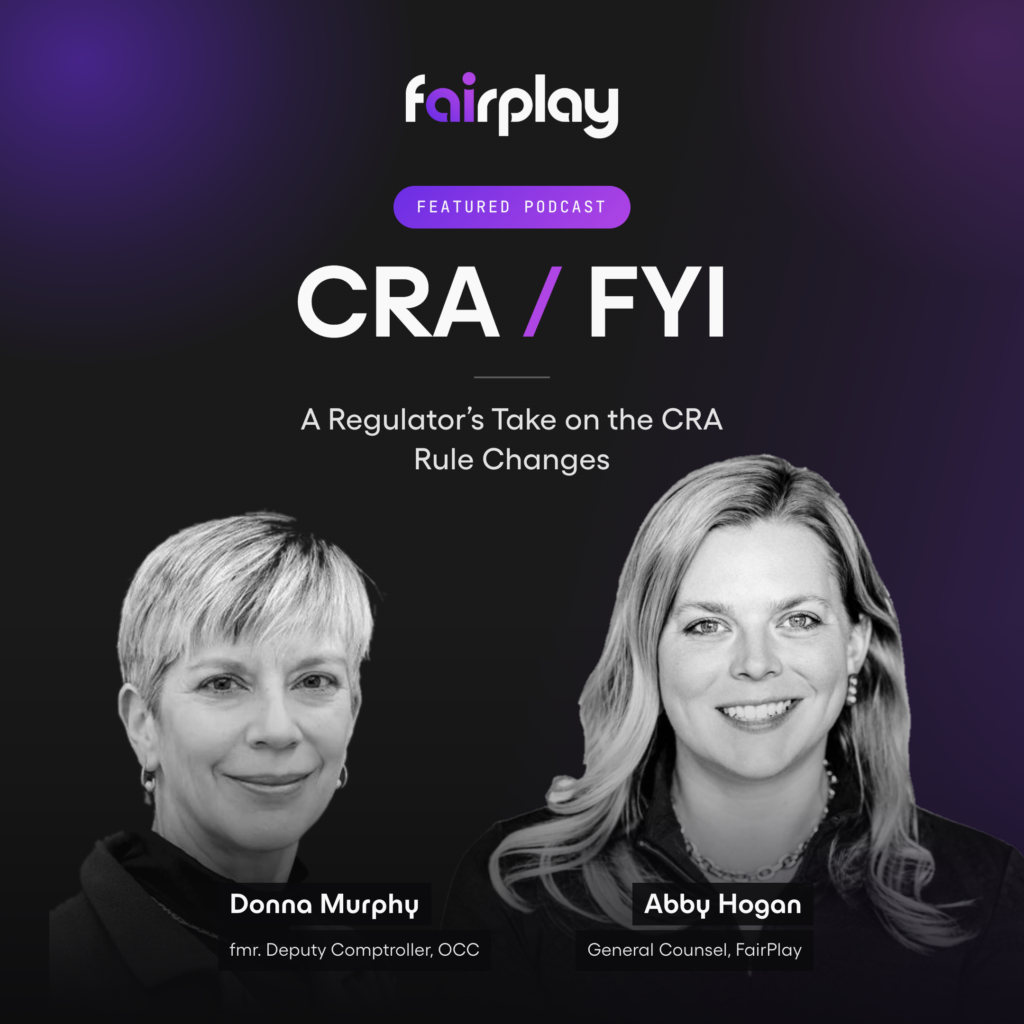

Few regulations have proven as vital, or as difficult to pin down, as the Community Reinvestment Act. The CRA has weathered false starts, court challenges, and rescinded rules in recent years, and its latest proposed overhaul could reshape it once again. This week, FairPlay launched a podcast series dubbed “CRA / FYI” that aims to unpack the CRA and to provide clarity to the teams that put it into practice.
Series host Abby Hogan, general counsel at FairPlay, welcomed her first guest, FairPlay advisor and former OCC deputy comptroller Donna Murphy. Murphy spent more than a decade working on fair lending, financial crime, and CRA supervision.
| Related: Watch Episode 2 in the CRA / FYI series: A Former Banking Chief Risk Officer Breaks Down the CRA Rule Changes
Five key takeaways
Their discussion dove into the OCC and FDIC’s newly proposed rule, announced July 31 and open for public comment through October 13. It comes alongside the agencies’ pending withdrawal of the never-implemented 2023 rule and would amend the 1995/2005 framework that remains in effect.
Here are five key takeaways from the discussion:
1. Asset thresholds are set for a major overhaul with major implications. The proposed changes would raise the small bank threshold to $1 billion and create a new intermediate category for banks between $1 billion and $10 billion, mirroring the Dodd-Frank cutoff. Anything above $10 billion becomes a large bank for CRA purposes, effectively moving hundreds of institutions into lighter regulatory tiers.
2. The Federal Reserve is sitting this one out, which could complicate things. Unlike prior rulemakings, this proposal comes only from the OCC and FDIC, with Murphy calling the Fed’s absence, “very interesting.” She notes that the last time a single agency went it alone, the OCC’s 2020 rule, it created confusion across the industry and was eventually challenged and rescinded.
3. This isn’t a clean-cut “regulatory relief” story. While some have branded the proposal as a burden reduction win for banks, Murphy pushed back on that assessment. Banks moving from large to intermediate status would shed some formal reporting duties, but they would still need to maintain enough documentation to satisfy examiners. Meanwhile, large banks would face a steep increase in documentation for community development grants and donations. Murphy calls it “more nuanced” than a simple relief narrative. Hogan added a related concern: Shrinking the pool of publicly reported CRA data would strip away a valuable “treasure trove” of business intelligence that banks and community groups currently use to benchmark themselves against peers and identify market gaps.
| Related: The State of CRA. What 80,000+ exams reveal about reaching Outstanding. See the findings
4. Intermediaries could feel the squeeze. Hogan flagged the network of nonprofits, CDFIs, and fintechs that help banks funnel investment into underserved “CRA deserts.” Because the rule tightens how grant related and lending connected activities count, these intermediaries, who Murphy noted often help serve borrowers without strong credit histories, may need to restructure relationships to stay compliant.
5. Don’t overreact yet. Both hosts agreed banks should study the proposal and understand where they’d land under it, but hold off on reactionary system or process changes. As Murphy put it, moving too fast “could lead to more of the yo-yo effect” that recent rule changes have yielded. With litigation likely and a final rule not expected before early to mid 2027, patience is the watchword.
The comment period runs through October 13, and Fairplay is encouraging bankers, community groups, and other stakeholders to weigh in. Future CRA / FYI episodes will bring additional voices and insights from across the CRA ecosystem.
Contact Fairplay AI to assess your current and future CRA strategy.