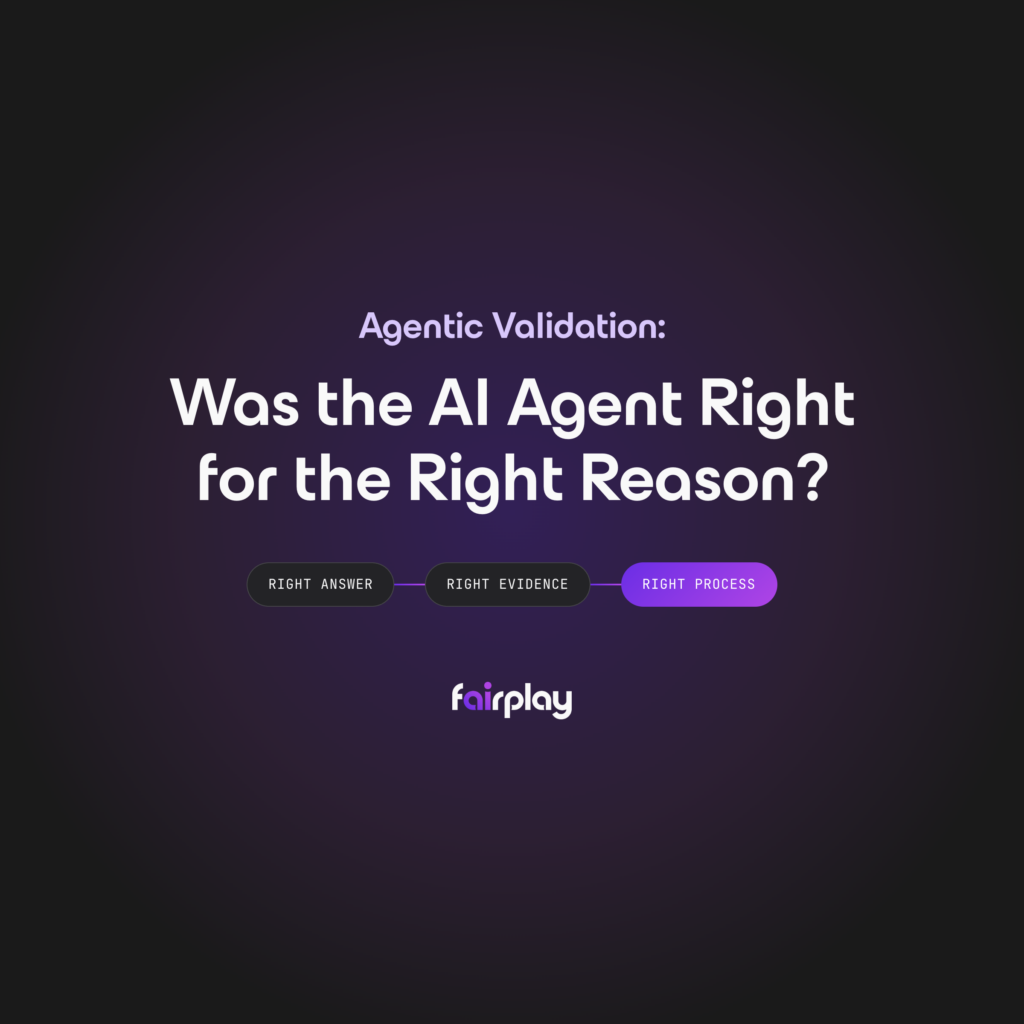
Agentic validation in financial services isn’t a practice that must be invented from scratch. Bank model risk management teams have spent more than a decade testing credit models for conceptual soundness, not just accuracy, because a model can be predictive for a bad reason, and an AI agent can be right for the wrong one.
Building on my last two posts on how an AI agent’s correct answer can be an evaluation failure and the three layers of AI agent correctness, this post shows how those model risk methods become a road map for validating agents that approve refunds, initiate payments and deny claims.
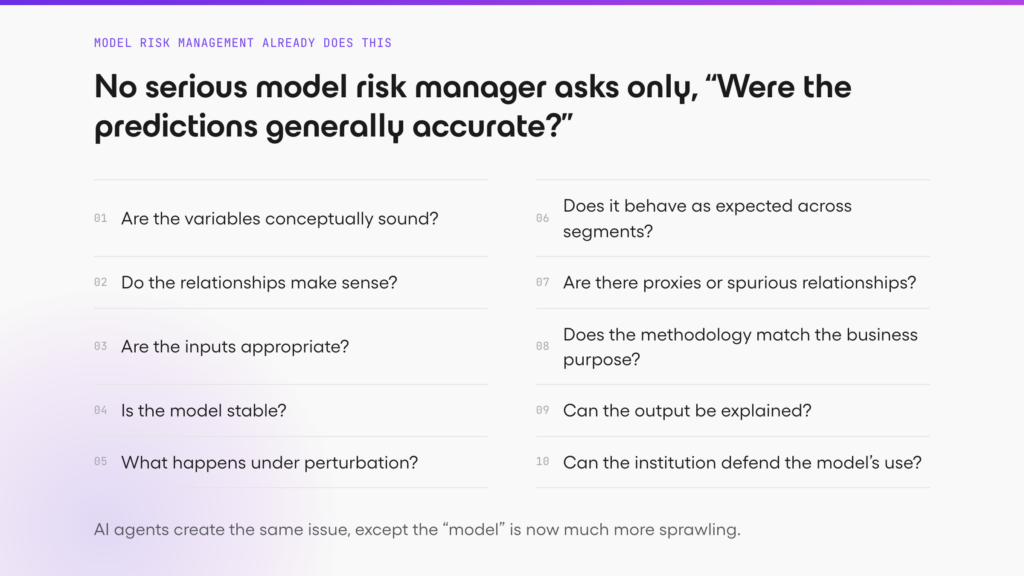
When validating a credit model, no serious model risk manager asks only, “Were the predictions generally accurate?”
They also ask the following:
- Are the variables conceptually sound?
- Do the relationships make sense?
- Are the inputs appropriate?
- Is the model stable?
- What happens under perturbation?
- Does the model behave as expected across segments?
- Are there proxies or spurious relationships?
- Does the methodology correspond to the stated business purpose?
- Can the output be explained?
- Can the institution defend the model’s use?
They ask these questions because a model can be predictive for a bad reason.
A variable may correlate beautifully with default while capturing something entirely unintended.
A model may perform well in a sample because it learned a temporary artifact in the data.
The performance metric does not answer the conceptual soundness question.
AI agents create the same issue, except the “model” is now much more sprawling. The system may include a foundation model, retrieval layer, prompt, tools, data sources, memory, policies and action logic. Still, the principle remains the same:
Performance is evidence of quality. It is not the entirety of quality.
Why agentic validation matters even when the customer never notices
It’s tempting to respond, “If the final answer was correct, why should I care?”
You should care because a correct result generated by a defective process is a harbinger of future failures.
Imagine an agent that makes the correct decision 99 times using faulty reasoning, and on the 100th case, the same faulty reasoning produces the wrong result.
The defect did not suddenly appear on case 100. It was there all along. Your outcome-only evals simply failed to detect it. That is what makes right-for-the-wrong-reason cases so valuable.
They are near misses in reverse.
Nothing bad happened.
But the system showed you a mechanism through which something bad could happen easily.
Industries with mature risk cultures rightfully take those signals seriously.
A pilot who lands safely after ignoring a critical warning light does not prove the warning light was unimportant.
A bank reconciliation that balances only because two errors offset each other is not a clean reconciliation.
A security control that failed but happened not to be exploited still failed.
The absence of a bad outcome does not prove the integrity of the process.
Agentic validation becomes more important as agents get more autonomous
When AI merely drafts text for a human to review, a brittle reasoning process is concerning.
When AI takes actions, it becomes something else.
Imagine agents that can:
- Approve refunds
- Alter account records
- Send communications
- Initiate payments
- Close cases
- Deny claims
- Escalate customers
- Generate adverse action notices
- Satisfy regulatory controls
Now, the process itself becomes an important control surface. The more autonomy the system has, the less comfortable we should be with, “Well, it usually gets the answer right.”
We need to know whether it gets the answer right reliably, and reliability requires something more than empirical coincidence.
It requires evidence that the system is using the right information in the right way.
An audit trail should capture more than the conclusion
This also has implications for agent logging.
Most organizations understandably want to record the user request, the agent response, the final decision, and perhaps the agent’s explanation.
But for important workflows, assurance may require much richer telemetry:
- What sources did the agent retrieve?
- Which records did it access?
- What information was discarded?
- Which tools were called?
- What did those tools return?
- What policy version was used?
- Were there conflicting facts?
- What confidence or uncertainty signals appeared?
- What intermediate state triggered the final action?
- Did the agent retry a failed tool?
- Did it override an earlier conclusion?
This is not about collecting data for the sake of collecting data.
It is about being able to reconstruct whether a good outcome resulted from a good process.
The benchmark needs intermediate ground truth
There is a practical problem here. Outcome evals are relatively easy to build.
Question. Answer. Compare.
Process evals require richer ground truth.
For an identity-resolution case, for example, the benchmark may need to specify:
- These are the two correct records.
- This article belongs to Person A.
- This identifier belongs to Person B.
- These three fields are relevant.
- That alias is unverified.
- This source should not be relied upon.
- The correct conclusion is now match.
- And because there is no match, the correct action is to suppress the case rather than escalate it.
That is considerably more work than attaching a simple pass/fail label to the final answer, but it produces considerably more information. You can now distinguish several failure modes:
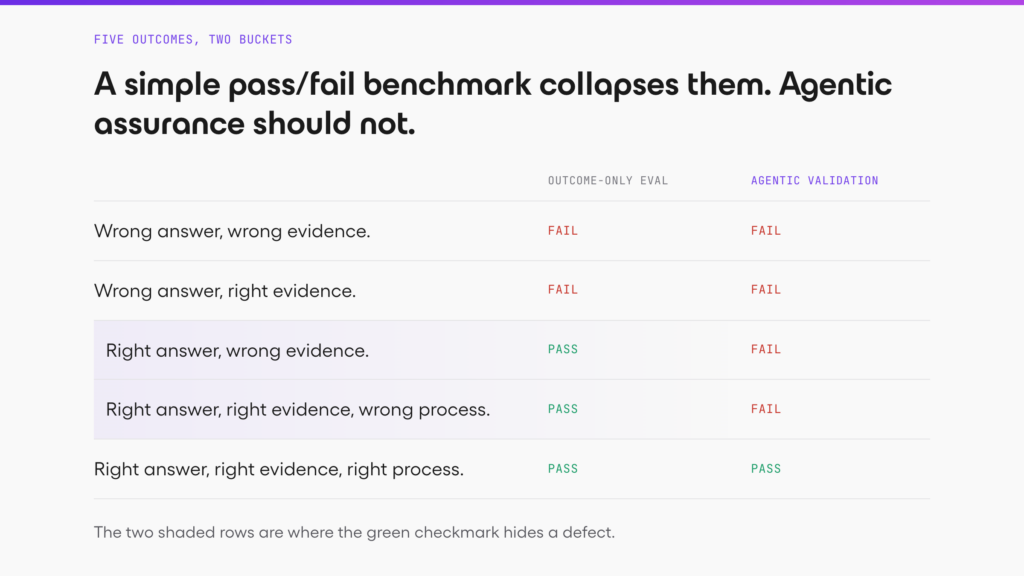
- Wrong answer, wrong evidence.
- Wrong answer, right evidence.
- Right answer, wrong evidence.
- Right answer, right evidence, wrong process.
- Right answer, right evidence, right process.
Those are very different outcomes from a validation perspective. A simple pass/fail benchmark collapses them into two buckets.
Agentic assurance should not.
Regulators will care about this distinction
This issue will become particularly important in regulated industries because those industries already place enormous emphasis on process.
A bank frequently cannot defend a consequential decision merely by pleading, “But the answer was correct.”
It may need to demonstrate that it used permissible information, followed established policy, maintained appropriate controls, provided required disclosures, documented the decision, and applied its procedures consistently.
An AI agent operating within that process inherits those obligations. If the agent reaches the correct lending decision using the wrong applicant’s information, that is not a successful lending process.
If it generates the correct complaint disposition but fails to consider a required piece of evidence, that is not necessarily a successful complaint process.
If it arrives at the correct fraud conclusion but bypasses a required verification control, that is not necessarily a successful fraud process.
The system cannot merely produce defensible outcomes.
It needs to produce outcomes through defensible mechanisms.
‘Explainability’ is not quite the right word for agentic validation
Some people might describe all of this as explainability, but that description is too narrow.
Explainability often focuses on whether we can generate a human-understandable account of why a system produced an output, which is useful.
But the more important issue is decision integrity.
Did the system reach the conclusion based on information and procedures that should legitimately produce that conclusion?
That incorporates explanation, but it also incorporates provenance.
Evidence quality.
Policy compliance.
Tool integrity.
Sequencing.
Abstention.
Escalation.
It’s a much richer question. And for autonomous agents, decision integrity will likely become one of the central pillars of assurance.
Your eval should sometimes fail a correct answer
This may be the most counterintuitive conclusion.
A mature agent evaluation program should contain situations where the agent produces the correct final answer and still fails the test.
- It fails because it relied on the wrong source.
- It fails because it conflated two people.
- It fails because it invented a fact.
- It fails because it skipped a required verification.
- It fails because it applied the wrong policy.
- It fails because an earlier mistake happened to be cancelled by a later mistake.
- It fails because its explanation does not match the evidence.
That is not being pedantic, but rather the whole purpose of validation. The objective is not to reward the agent for being lucky.
The objective is to determine whether we can trust it when luck runs out.
Agentic assurance should ask a harder question
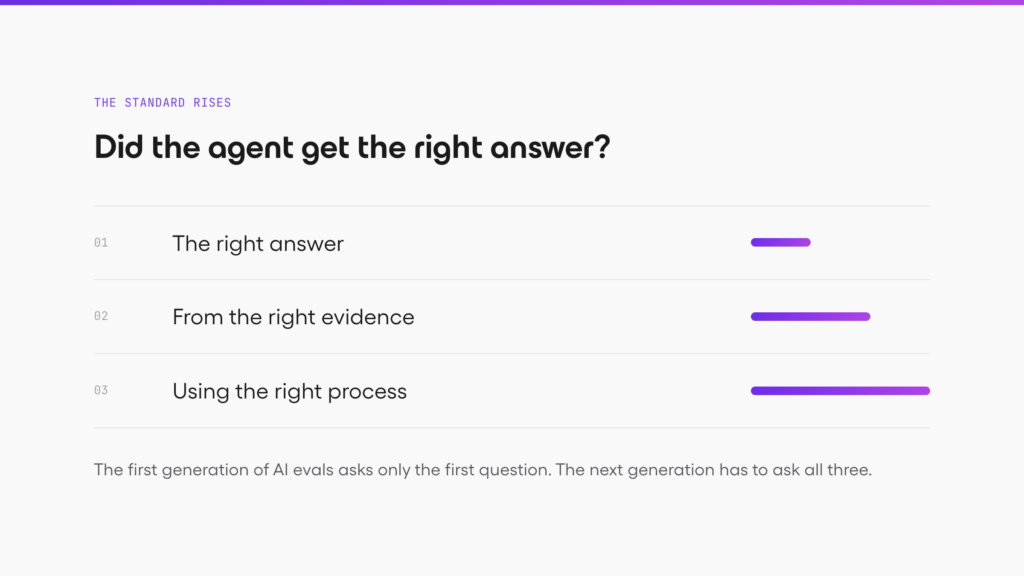
The first generation of AI evals asks, Did the agent get the right answer?
The next generation needs to ask, Did the agent get the right answer, from the right evidence, using the right process?
That is a much higher standard.
It is also the standard that consequential AI systems will increasingly have to meet.
Because there is a profound difference between an agent that is correct and an agent that is reliably correct.
One gets the right answer.
The other gives you a reason to believe it will keep getting the right answer when the facts change, the tools fail, the cases get harder, and the stakes increase.
So, when your eval dashboard shows another green checkmark, do not stop at, Was the agent right?
Ask the more important question: Was it right for the right reason?