Preemption in banking law is one of the thorniest issues in U.S. financial services. I recently heard a banking lawyer say that advising clients on preemption is “entirely in the eye of the beholder.” In practice, they’re pointing to the legal, political, and interpretive uncertainty that surrounds the question of when federal banking law overrides state law.
This uncertainty shapes how banks, fintech companies, and regulators behave and ultimately affects credit availability, compliance costs, and consumer protection.
The Legal Foundations of Preemption
Preemption derives from the Supremacy Clause of the U.S. Constitution, and refers to the principle that federal law displaces conflicting state law. In banking, the question often arises when state consumer protection, usury, or licensing laws interact with federal statutes such as the National Bank Act (NBA), the Home Owners’ Loan Act (HOLA), or the Federal Deposit Insurance Act (FDIA).
Historically, the Supreme Court has recognized multiple preemption types:
- Express Preemption: When Congress explicitly states in a statute that federal law displaces state law.
- Field Preemption: When federal regulation is so pervasive that courts infer that Congress intended to “occupy the field,” leaving no room for state law.
- Conflict Preemption: When it is impossible to comply with both state and federal law, or when state law is seen as standing as an obstacle to the accomplishment of federal objectives.
Banking law involves all three types, but often the dispute centers on conflict preemption, determining whether a state requirement significantly interferes with a bank’s exercise of powers granted under federal law.
Why Preemption Is So Difficult in Banking
Four key factors make preemption analysis one of the hardest questions for banking lawyers:
- Ambiguous Statutory Language: Many federal banking statutes were drafted in the 19th or early 20th centuries. They speak broadly of national banks’ powers to engage in “business of banking” or “incidental powers,” but they lack preemption specifics. Lawyers and courts must infer preemption from general language rather than explicit directives.
- Evolving Case Law: Landmark cases like Barnett Bank v. Nelson (1996) and Watters v. Wachovia (2007) clarified (but did not settle) the boundaries of preemption. The Dodd–Frank Act (2010) codified the Barnett standard (“prevents or significantly interferes with”) but also imposed new procedural requirements on the OCC before issuing preemption determinations. Courts interpret “significantly interferes” differently, leading to circuit splits and unpredictability. The Supreme Court’s 2024 decision in Cantero v. Bank of America — its first preemption ruling since Dodd-Frank codified the standard — was supposed to bring clarity. As discussed below, it did the opposite.
- Regulatory Shifts: The OCC and FDIC have taken more expansive or more restrained views of preemption depending on the administration in power. For instance, under President George W. Bush’s administration, the OCC was assertive in preempting state laws, while under President Barack Obama’s administration and afterward, there has been greater willingness to allow states to enforce consumer protection rules. These shifts mean that advice given today may not hold tomorrow. For example: in May 2026, with the escrow-interest question still bouncing between courts, the OCC issued a determination concluding that federal law preempts state escrow-interest requirements — a federal regulator placing its thumb on the scale mid-litigation.
- Fact-Intensive Analysis: Whether a state law “significantly interferes” with a bank’s powers is highly fact-specific. A disclosure requirement in one context may be preempted, while in another it may not be. Lawyers must carefully analyze the nature of the state law, the specific bank activity, and the regulatory environment, often with incomplete information.
Competing Views on Preemption
The legal and policy debates around preemption divide into two broad camps:
- Broad Preemption Advocates: These argue that a uniform national banking system requires sweeping preemption to prevent a patchwork of state laws from burdening banks. They emphasize efficiency, consistency, and the ability to deliver nationwide products.
- Narrow Preemption Advocates: These favor preserving state “laboratories of democracy” and argue that state laws provide critical consumer protections. They caution that broad preemption can lead to regulatory gaps, as seen in the 2008 financial crisis when federal regulators failed to check abusive lending practices.
Courts and regulators must navigate between these poles, and different judges, agencies, and administrations strike different balances.
‘In the Eye of the Beholder’
When banking lawyers say that preemption is “entirely in the eye of the beholder,” they’re acknowledging that the answer often depends less on black-letter law and more on who is looking at the question:
- Courts differ — but not along simple partisan lines. Judges who prize national uniformity and predictability lean toward preemption; judges who prize federalism and the states’ traditional role in consumer protection lean against it. Neither instinct maps cleanly onto ideology. Cantero itself is the proof: a unanimous Supreme Court, in an opinion by Justice Kavanaugh, rejected the broad preemption approach — and the appeals courts that later split over the same law don’t sort into red and blue.
- Regulators shift with administrations, taking more expansive or more restrained views of preemption depending on who’s in charge.
- Clients and Lawyers must therefore assess not only the law but also the likely forum, political climate, and regulator in play.
In other words, the same state statute might be seen as preempted in one circuit and upheld in another. There is no definitive answer, only a spectrum of risk that must be managed.
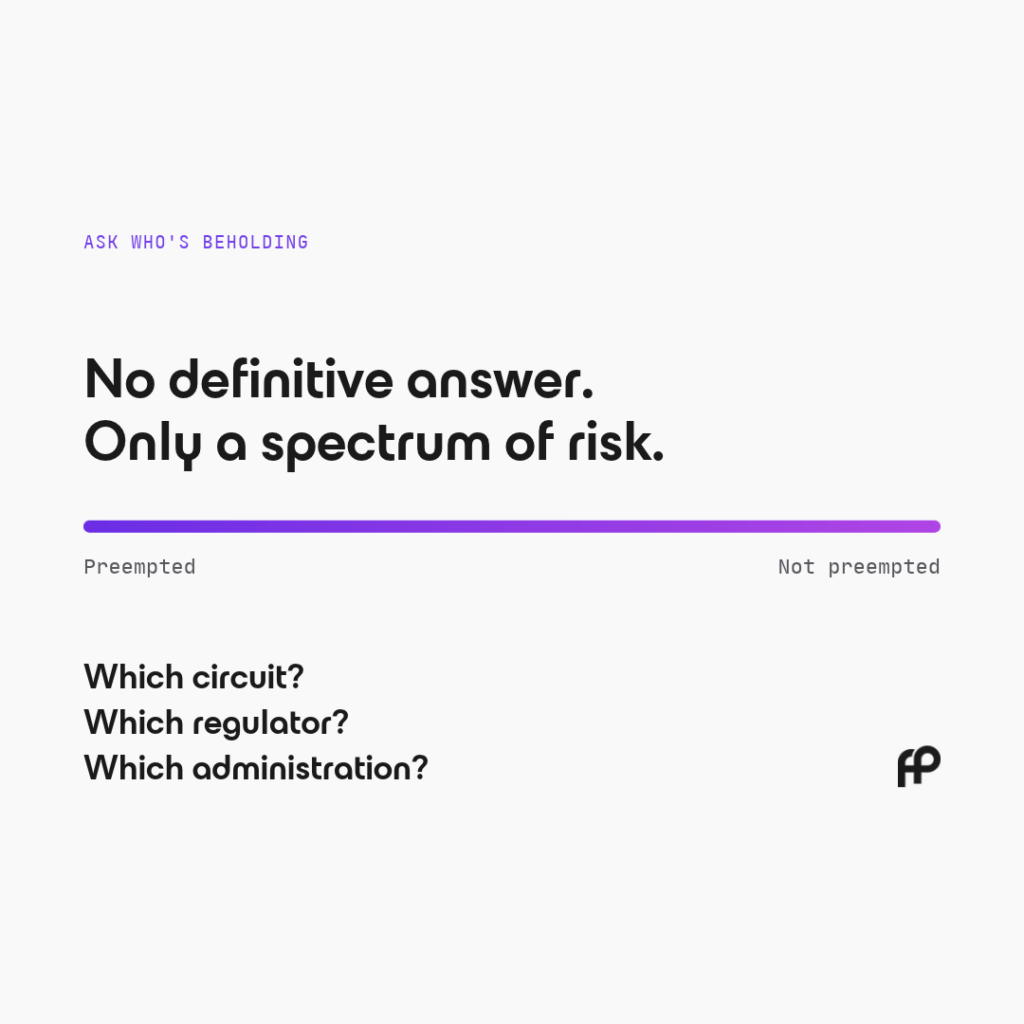
Exhibit A: The Cantero Saga
If the “eye of the beholder” framing sounds like exaggeration, consider what has happened in the courts over the past two years.
New York has a law requiring mortgage lenders to pay borrowers at least 2% interest on money held in escrow accounts — the accounts where your monthly payments toward property taxes and insurance sit until the bills come due. A group of borrowers sued Bank of America, a national bank, for not paying that interest. The bank’s defense: as a national bank, it answers to federal law, and federal law doesn’t require interest on escrow. New York’s law, the bank argued, was preempted.
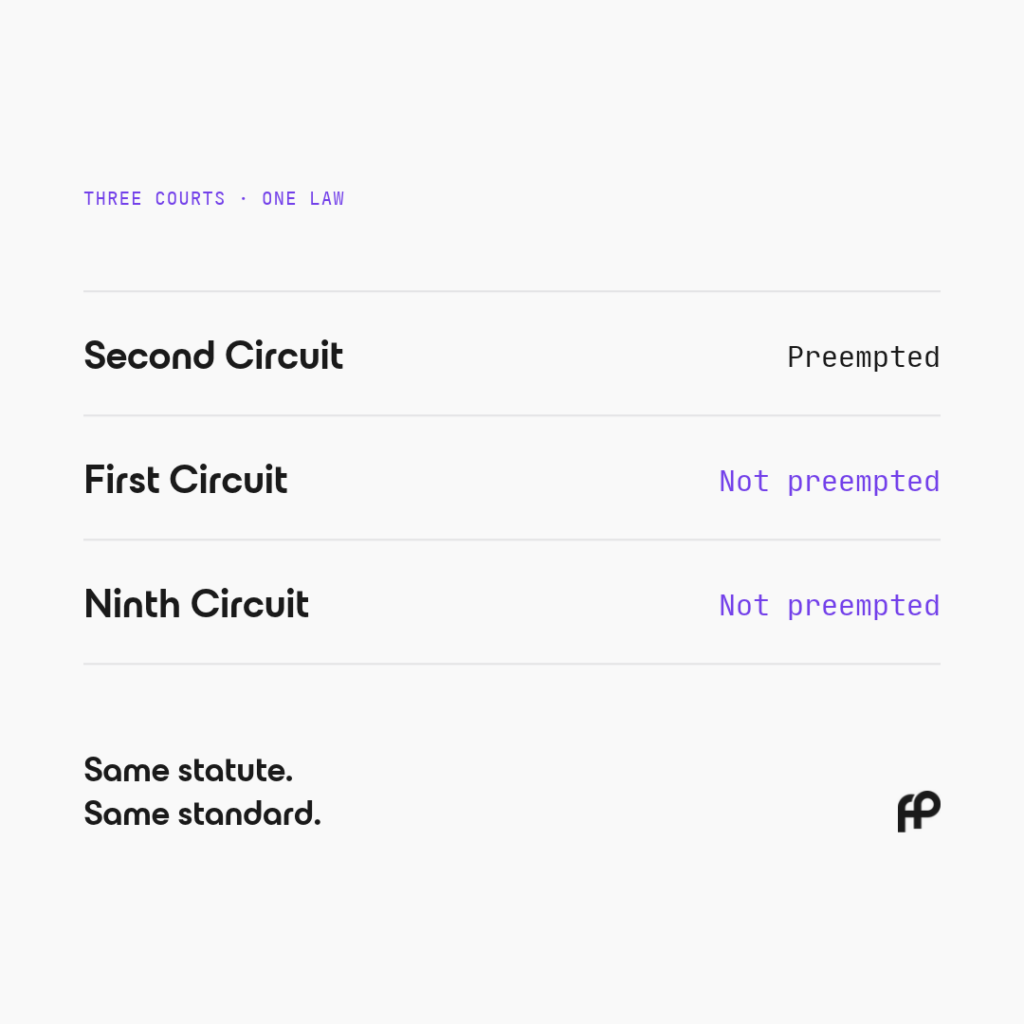
The Second Circuit — the federal appeals court covering New York — agreed with the bank. The borrowers appealed to the Supreme Court, which in 2024 did something notable: all nine justices, unanimously, threw out the Second Circuit’s decision. The appeals court, they said, had applied the wrong analysis. It couldn’t simply declare that any state law touching a banking power was preempted; it had to conduct a “nuanced comparative analysis,” weighing how much the state law actually interfered with the bank’s business against prior cases. The Supreme Court sent the case back down with instructions to try again.
Here’s where it gets interesting. The Second Circuit redid the analysis under the Supreme Court’s new instructions — and reached the exact same conclusion: preempted. The bank doesn’t have to pay.
Meanwhile, the First Circuit, covering New England, examined Rhode Island’s nearly identical escrow-interest law under the same Supreme Court framework and concluded it was not preempted. The bank has to pay. The Ninth Circuit, covering the West Coast, also declined to find preemption in a similar case.
Pause on that. A unanimous Supreme Court announced the test. Three appeals courts applied it to essentially the same law. They split. The question is now headed back to the Supreme Court for a second time, and until it’s resolved, whether a national bank owes its escrow customers interest depends on which side of a circuit boundary the customer lives.
The same statute. The same standard. Different beholders. Different law.
Implications for Practice
Because preemption questions are so indeterminate, banking lawyers often provide risk-based advice rather than a simple yes/no answer. They may consider:
- Litigation risk: How likely is a challenge, and in what forum?
- Regulatory posture: Is the OCC, FDIC, or CFPB likely to support or oppose preemption in this context?
- Business impact: Would complying with the state law materially harm the bank’s ability to offer the product?
This kind of counseling is as much art as science, requiring lawyers to blend doctrinal analysis, regulatory insight, and judgment about litigation outcomes.
The Takeaway
Preemption in banking law remains one of the most nuanced and contested areas of legal practice. Its difficulty stems from ambiguous statutes, evolving case law, political and regulatory swings, and the inherently subjective nature of determining what constitutes a “significant interference” with federal banking powers. The lawyer’s remark that it is “in the eye of the beholder” captures the reality that preemption is rarely a purely legal question. It is a predictive exercise about how courts and regulators will view the issue, requiring as much strategic foresight as legal interpretation.