Every few months, the AI industry gets a new “best model.” It boasts some combination of better reasoning, higher benchmark scores, longer context windows, improved tool use, or fewer hallucinations.
The temptation is obvious: Upgrade!
If Model B is smarter than Model A, why would you keep using Model A? But that question assumes something that is often false. It assumes the model is the product, but for most production AI systems, that’s not the case.
The model is one component inside a larger system that also includes prompts, retrieval, tools, workflows, business rules, latency requirements, cost constraints, escalation logic, and human review.
Change the model and you may change all of those things at once. That’s why model upgrades should be treated less like software patches and more like system migrations.
A new model does not simply answer the question, Is this model better?
It reopens a much harder question: Better for what?
With AI model selection, the best model is not necessarily the best agent
Suppose a new model improves task accuracy from 93% to 96%. That sounds like an obvious win.
Now, suppose it also:
- doubles inference cost
- adds three seconds of latency
- uses tools more aggressively
- produces longer outputs
- fails differently on ambiguous cases
- refuses more often
- behaves less consistently when the same task is repeated
Still obviously better? Maybe.
The answer depends on the workflow. For an internal research assistant, three additional seconds may not matter. For a customer-facing checkout flow, it might. In the case of a low-volume investigation workflow, doubling model cost may be irrelevant, but it may radically change the economics for an agent processing 50 million transactions a month.
This is why “Which model is best?” is usually the wrong question. The better question is:
Which model configuration gives this particular workflow the best acceptable combination of accuracy, reliability, speed and cost?
That’s an optimization problem.
AI teams love leaderboards
Leaderboards are seductive because they collapse complexity into a ranking.
Model A: 87.4.
Model B: 86.9.
Model C: 84.2.
There. Decision made.
The problem is that production systems do not live on leaderboards. They live inside businesses.
A production agent may need to answer in under 500 milliseconds or process a case for less than two cents. Maybe it needs exceptionally high recall in some cases, or it needs a low false-positive rate. Perhaps it’s critical for it to know when to defer to a human.
The model with the highest general-purpose benchmark score may not be the model that performs best against any of those constraints.
In other words, model capability is only one variable in production utility.
As agents become more operational, the other variables simply matter more.
Think in frontiers, not rankings
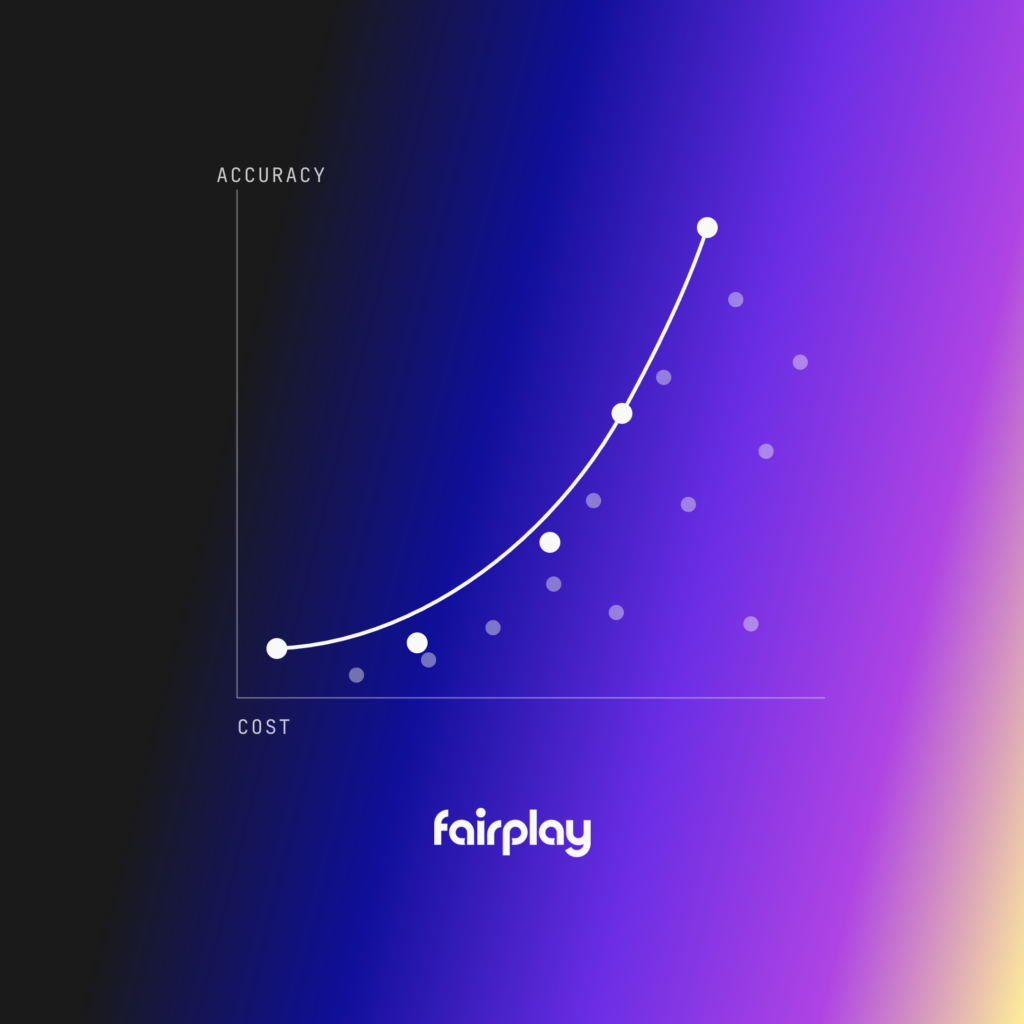
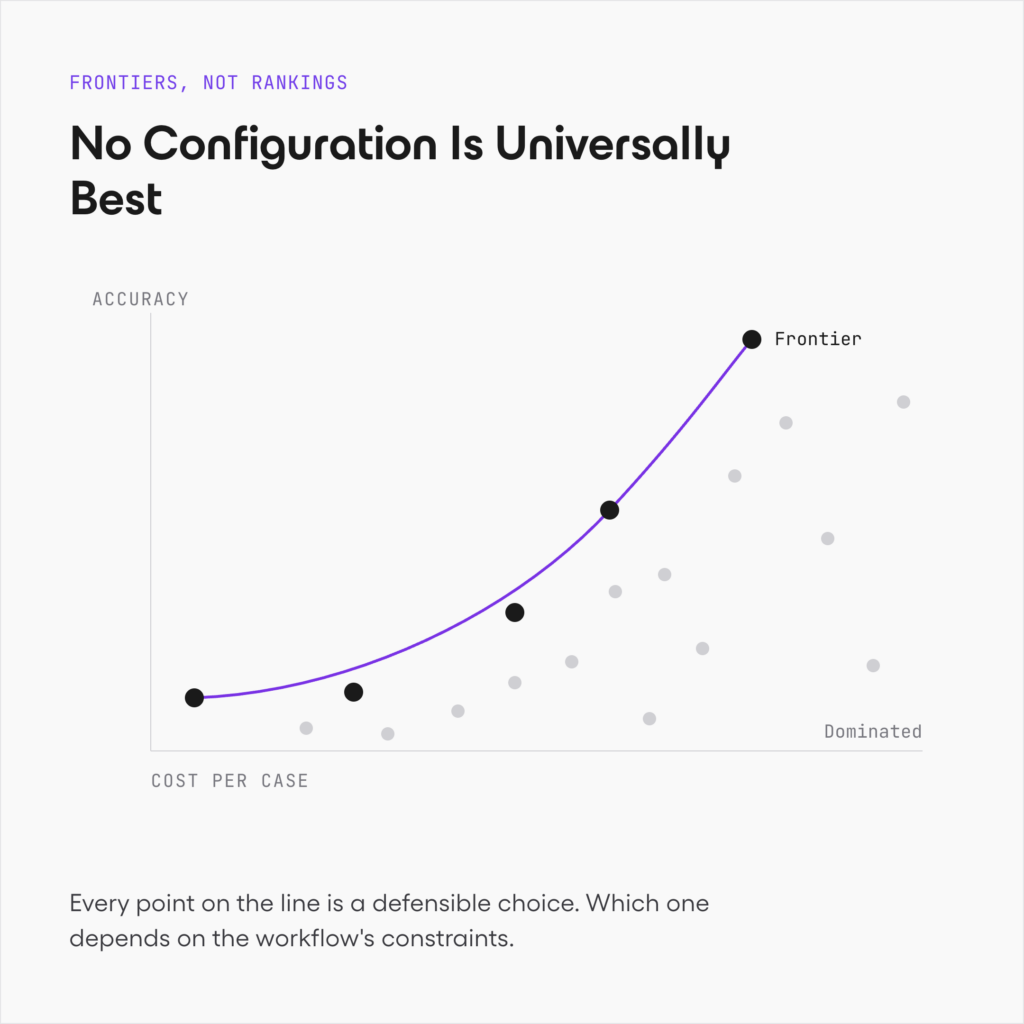
Economists and engineers have a useful way of thinking about problems like this: a Pareto frontier.
A Pareto frontier is essentially the set of best possible tradeoffs in a situation with competing goals. Think of it as every option where you can’t make one thing better without making another thing worse, meaning that anything on the line is a genuinely smart choice depending on what you value most. Let’s look at it in the context of AI models.
Imagine plotting every viable agent configuration across four dimensions:
- Accuracy
- Reliability
- Latency
- Cost
Some configurations are obviously inferior. One system is slower, more expensive and less accurate than another.
Easy decision.
But most real choices are not like that. Instead, you get tradeoffs. One configuration is slightly more accurate but significantly more expensive. Another is extremely fast but somewhat less reliable on complex cases. Another performs brilliantly on hard cases but has poor economics for routine ones.
None is universally “best.”
The job is to decide which point makes sense for the business process, and that is far more useful than asking who won the latest model horse race.
Accuracy is usually not a scalar
Accuracy can hide complexity. Just imagine that Model B beats Model A overall: 96% versus 94%. Excellent. Now, break down the performance:
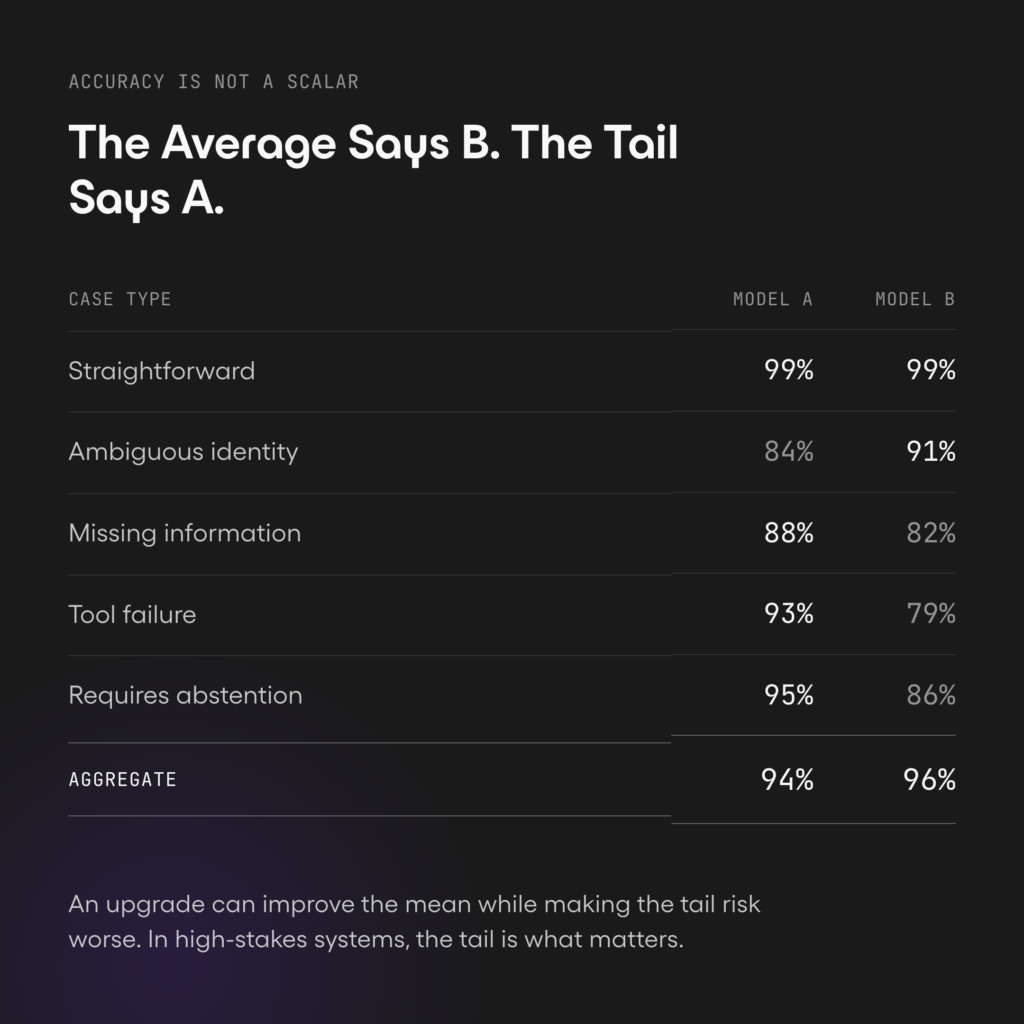
Which model is better?
The aggregate metric says Model B. The operating environment may say Model A.
Or, perhaps the answer is to use Model B only for certain use cases.
That’s why model evaluation should move beyond averages. You need to understand where the gains and regressions occur. An upgrade can improve the mean while making the tail risk worse. In high-stakes systems, the tail is often what matters.
Reliability is different from accuracy
Reliability is a separate axis. Two models both hit 95%. Model A returns the same answer nearly every time you re-run a case. Model B sometimes says yes, sometimes no, sometimes insufficient information. Same average, very different production behavior, and in a regulated workflow most teams take the one whose behavior they can characterize. Consistency is half of it. Predictable failure is the other half.
Does the model recognize when it lacks the information to answer? Does it behave on Tuesday afternoon in production the way it behaved on Monday morning in validation?
The most intelligent model is not necessarily the most operationally dependable model, and once an AI system can take actions, dependability matters enormously.
Faster can be better than smarter
People occasionally talk about latency as though it is merely a user-experience consideration, which can be true. But sometimes it’s an architectural constraint.
Consider a fraud agent reviewing transactions in real time. A theoretically superior model that takes eight seconds to reach a decision may be unusable if the authorization decision has to occur in hundreds of milliseconds.
Or consider an agent assisting a call-center employee. If each turn adds five seconds of silence, the system may be too cumbersome to use no matter how brilliant its answers are.
Latency also compounds. A multi-step agent might make six model calls, meaning an additional two seconds per call is now 12 seconds. Add retrieval and external tools and the difference between a snappy agent and a painfully slow one becomes enormous and potentially costly.
Sometimes a slightly less capable model that responds quickly and predictably is the better production system because the goal is not to maximize intelligence in the abstract.
The goal is to maximize utility under real-world constraints.
Every model upgrade changes the economics, too
Suppose Model B is twice as expensive per token but produces answers half as long. Actual cost may barely change.
Or suppose it reasons more efficiently and requires fewer retries. Effective workflow cost may decline even if per-token pricing increases.
Conversely, a cheaper model may call external tools three times as often. Those tools may themselves cost money, or the model may make more errors that require human review.
This is the moment that the “cheap” model becomes expensive.
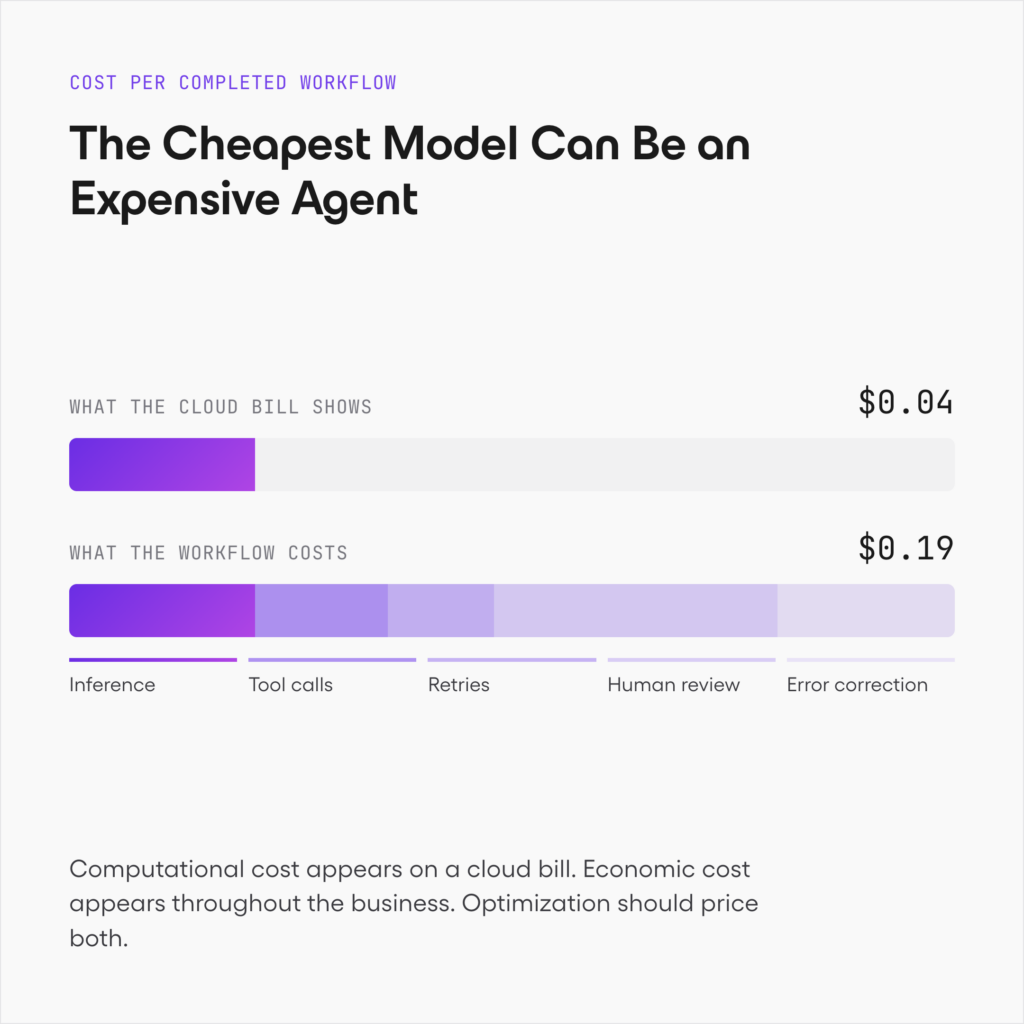
The relevant cost metric is therefore rarely cost per model call. In fact, it’s closer to cost per successfully completed workflow. That includes model usage, tool usage, retries, human review, error correction, latency, and sometimes the economic cost of incorrect decisions.
This is the core paradox we’re trying to avoid: the cheapest model can be an expensive agent.
Failure costs belong in the optimization, too
Failure costs become especially important in regulated financial services. Suppose one agent costs $0.04 per transaction and another costs $0.07.
At first glance, the first agent appears to be the cheaper of the two. But suppose the cheaper system produces materially more false positives, triggering manual investigations. Those lead to:
- Customer friction
- Appeals
- Operational queues
- Potential complaints
Now, the economics look different.
Or suppose it creates a slightly higher probability of a serious compliance error. The expected cost of that failure may dwarf, and ultimately negate, the inference savings. Therefore, we need to distinguish between computational cost and economic cost.
The first appears on a cloud bill. The second appears throughout the business.
Good agent optimization should care about both.
This starts to look like constrained optimization
The right framework is not one that maximizes accuracy. Instead, the goal should be to maximize system utility, subject to constraints.
- Accuracy must exceed X.
- False positives must remain below Y.
- Critical failure rate must stay below Z.
- Latency cannot exceed 800 milliseconds.
- Cost must remain under three cents per case.
- Certain workflows must always escalate to humans.
- Certain tool calls must always occur.
- Certain errors are simply unacceptable regardless of aggregate performance.
Once those constraints are explicit, model selection lends itself to reason.
The goal is no longer finding the smartest model. It becomes finding the best feasible configuration.
Where that leaves your next upgrade
None of this is an argument against new models. A seven-point gain on ambiguous identity cases is worth having, and some of the models arriving this year will be worth migrating to. The argument is narrower. The case for migrating has to be made against your constraints rather than against a ranking, and most of the numbers that decide it do not appear on the model card.
Which raises the practical question. If the model is one component in a configuration, what exactly do you have to re-examine when you swap it out?
More than most evaluation suites currently cover. Tool sequences change without changing the final answer. Greater capability introduces new failure modes rather than only removing old ones. And once you accept that different cases have different economics, the best answer often stops being a single model at all.
And that is the question for Part 2: How do you know when a model upgrade actually makes the system better?