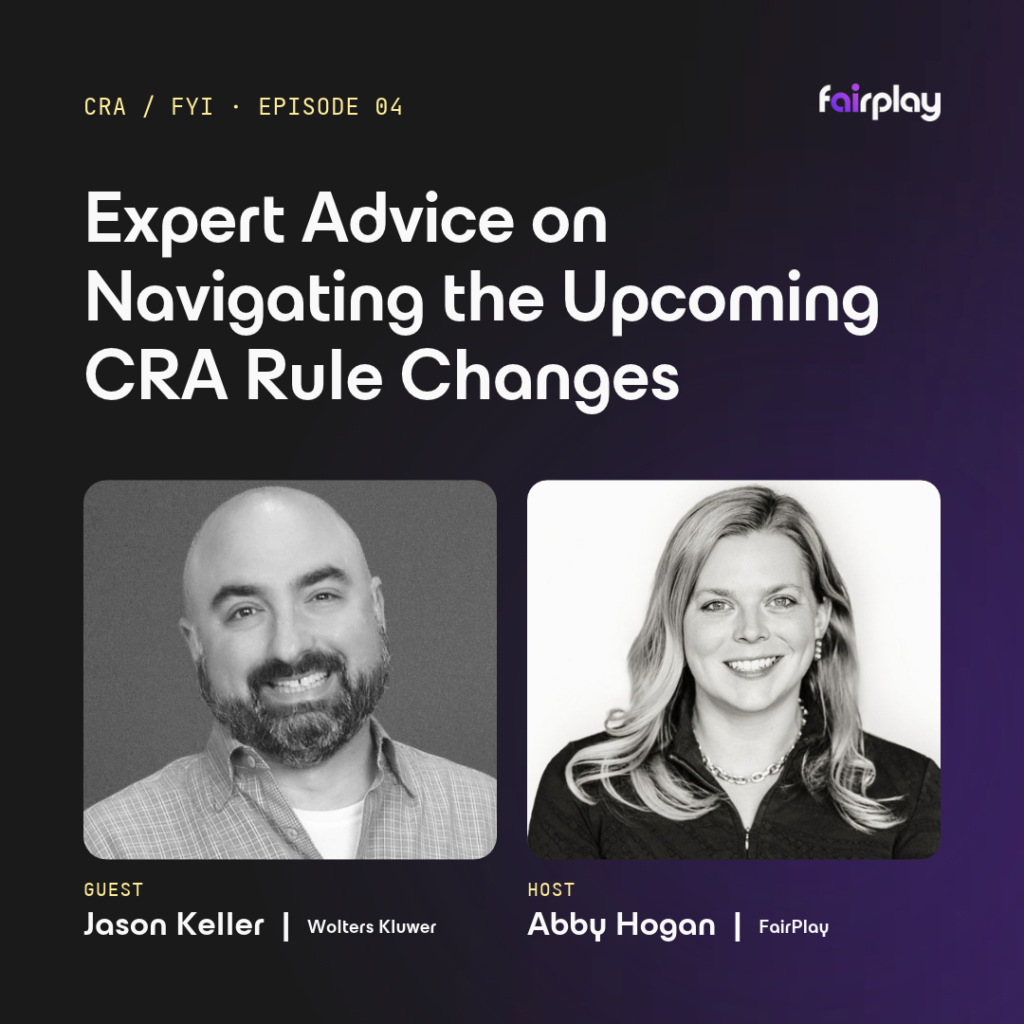

In episode four of FairPlay’s CRA / FYI podcast series, host Abby Hogan, FairPlay general counsel, welcomes Jason Keller, director of product management at Wolters Kluwer Compliance Solutions.
Keller spent more than 20 years at the Federal Reserve Bank of Chicago, most recently as a community and economic development senior advisor. He started examining banks for CRA compliance in 1998, three years after the 1995 rule took effect, and he is a commissioned bank examiner who has worked with community, regional, and large institutions in urban, suburban, and rural markets.
The two discuss the notice of proposed rulemaking issued by the OCC and FDIC, including the $10 billion large bank threshold, the changed treatment of grants and donations, and Keller’s advice to CRA officers as they prepare for these changes.
Comments on the proposal are due Oct. 13.
Watch the Full Episode
Time Stamps
[0:00] Welcome and introductions
[1:41] Jason Keller’s background with the Community Reinvestment Act ecosystem
[2:51] What has changed in the Community Reinvestment Act, and what has not
[3:42] Why Outstanding CRA ratings should be celebrated
[4:38] Why Outstanding CRA ratings never happen by accident
[5:26] They keys to Outstanding CRA ratings
[6:48] Jason Keller’s to the notice of proposed rulemaking
[8:45] The need for better definitions around “community development” and the changes to asset sizes
[10:29] Jason’s advice to banks while the proposed CRA rule change is pending
[12:50] The best CRA evaluation criteria
[13:57] Winners and losers under the proposed rule
[15:10] What nonprofits, CDFIs, and associations should be commenting on
[17:06] Tracking products, services, and community impact
[19:09] The changes that Jason Keller would make to the proposed CRA rule changes
[20:59] Clearer standards for responsiveness, complexity, and innovation
[23:17] Data quality and the missing life of a loan
[24:40] Gentrification, homeownership, and intergenerational wealth
[26:44] Job creation, retention, and workforce partnerships
[28:00] Conclusion
Full Podcast Transcript
Intro: Jason Keller, Wolters Kluwer Compliance Solutions
Abby Hogan [00:00]: Hello and welcome to FairPlay’s podcast on the Community Reinvestment Act, or CRA. Today we’re joined by longtime friend of FairPlay and expert over at Wolters Kluwer, Jason Keller. Jason is the director of product management over at Wolters Kluwer Compliance Solutions, and we’re so thrilled to have him here today.
Jason is a director within the product management function over at Wolters Kluwer. Joining in 2021, he is responsible for market strategy within the financial and corporate crimes and fair and responsible banking product lines, including compliance with the Community Reinvestment Act. Prior to this role, Keller spent over 20 years at the Federal Reserve Bank of Chicago, where most recently he served as a community and economic senior advisor.
In that role, he was responsible for overseeing and evaluating economic capabilities and sustainable growth opportunities by conducting seminars, workshops, and preparing written materials, and providing thought leadership on aspects of the CRA, community development, and applicable fair lending laws and regulations.
Keller is also a commissioned bank examiner and has served in leadership roles assessing compliance with various consumer protection regulations in community, regional, and large banks, as well as bank holding companies in urban, suburban, and rural markets. Really impressive resume, Jason. We’re so happy to have you on the podcast.
Jason Keller: Well, Abby, thank you so much for having me. It’s a very exciting time right now in CRA, and looking forward to the dialogue here today.
Abby Hogan: Great, so happy to have you here. So let’s start with how long you’ve been in the CRA ecosystem. It sounds like you’ve been around different parts of this for quite a while. How did you get started, and how long have you been here?
Jason Keller’s background with the Community Reinvestment Act
Jason Keller [1:41]: Yeah, so I started in the Community Reinvestment Act in 1998 as a junior examiner coming right out of undergrad, and the 1995 rule was only about three years old. So there was still very much a focus on compliance with the 1995 rule, as there is today. But obviously at that period, almost 30 years ago, there wasn’t nearly the level of automation, there wasn’t nearly the level of technology, there wasn’t nearly the level of oversight.
But as I think about what is the same, it’s still the commitment of local financial institutions to lend and invest in the markets that they serve. That’s really always been the core platform, always been the core purpose. And it’s exciting here in 2026 to really be focused on the same thing that I used to examine for starting in 1998.
Abby Hogan [2:37]: That’s incredible. It’s quite a long run already, three decades working with this one regulation. Have you seen it change quite a bit over the years, or has it been a relatively stable compliance environment?
What has changed in the Community Reinvestment Act?
Jason Keller [2:51: No, absolutely, absolutely quite a bit of change. And the technology piece, which I’m sure we’ll get into with Wolters Kluwer’s relationship with FairPlay and whatnot, but really what has changed is this idea of impact.
And there’s always been a stress on documentation. There’s always been a stress on, you know, tell me what you are doing, tell that regulator, tell the community how you are serving. But it’s really this idea of the impact of every dollar, every hour spent, every loan, every investment, every service being captured in part of the storytelling that a financial institution has to go through every two, three, four, or even five years as they talk about how they comply with this very, very important regulation.
Why Outstanding CRA ratings should be celebrated
[3:42] And I’m a firm believer that in my years of working with CRA, that while financial institutions want to do this work, there are still a handful out there that feel like they have to. And I believe that from a strategic focus with the right data on hand, with the right emphasis, the right commitment, every institution should at least be rated Satisfactory. But those that are able to reach that Outstanding threshold, that deserves a pat on the back, not just regulatorily, but from the community as well. It’s not easy to receive an Outstanding. The standards to receive an Outstanding aren’t always clear and crisp. But those who get there, I believe that it should be celebrated and promoted as yes, we are not only serving our community, but we are serving our community in a way that the regulators are recognizing, and it’s not very commonplace to get that Outstanding.
Abby Hogan [4:31]: Yeah, do you find anyone gets there accidentally, or are all of those banks getting there with very intentional effort?
Outstanding CRA ratings never happen by accident
Jason Keller [4:38: Nope, I talk about this all the time. CRA compliance does not happen by accident. Those that receive an Outstanding rating do not get there by default, even if they are well known in the community, if they are out there, if they have their logo plastered all throughout a given area. It takes a concerted effort from the board of directors, whether a family-owned business or whatever it is, to be able to say that we are going to not only comply with the CRA, we are going to excel at it. We are going to meet that unmet market need. We are going to address the needs of small businesses and small farms inside low- and moderate-income communities. We’re going to focus on those underserved middle income distressed areas. Again, CRA does not happen by accident.
They keys to Outstanding CRA ratings
[5:26] In working with the biggest banks across the country, regional banks, community banks, those institutions that have a dedicated staff are the ones that do the best. Those that have the best technology are the ones that do the best. Those that have mandatory hours for the service test do the best. Those that require documentation up front and have relationships with those nonprofit entities do the best.
Different ways to comply with the CRA. The regulation itself, the procedures, are not a checklist. It is very much a handbook. It is very much a playbook. A lot of different ways to get there. But I’ve seen institutions do well in a lot of different ways. And hopefully as this podcast gets around, your institution will be able to comment and say, yes, this is how systematically we comply with this very important regulation.
Abby Hogan [6:20]: Those are all great points. There is just so much that goes into CRA compliance. Like you said, all of these different elements and all of this coordination. Pivoting back to the idea of this changing regulatory environment, we know the proposed rule came out a couple of weeks, I guess coming up on a couple of months ago now. So, talk to us. Were you surprised to hear about the notice of proposed rulemaking, or was that something you were expecting to see coming down the pipeline?
Jason Keller’s to the notice of proposed rulemaking
Jason Keller [6:48]: Very much expecting it. You know, as the proposed rule and then the final rule was challenged and then challenged again, it’s not a surprise in 2026 we got another notice of proposed rulemaking. It is somewhat of a surprise that the Federal Reserve didn’t come along for that, but I do know that they’ll be able to review the comments, they’ll be able to react. Right now, at the time we are filming this, there’s about a month left in the comment period. Those 60-some questions are ones that I know a lot of our customers are talking to us about.
Am I surprised about some of the questions? No. Am I surprised that there is a pivot from the final rule that was issued a couple years back? No. But what I am surprised about is this idea of what the industry still wants. And what the industry still wants is still that illustrative list of activities. That’s something that the OCC talked about many years ago. So again, that’s not a surprise. Am I surprised that there’s going to be clarifications, or proposal for clarifications, on what counts inside versus outside of an assessment area? Not a surprise.
Am I surprised that there’s different treatment of grants and donations? Yes, that is one area in the proposal that did surprise me, because grants and donations are the area that essentially are the easiest to document and the easiest to qualify.
It’s those larger investments that I think create the most amount of work for a financial institution and the most amount of work for a regulator to assess. But those are the ones that have the greatest impact, that greatest book value over time. But a basic grant or donation, not basic to get through, but really the impact is short-lived.
The need for better definitions around “community development” and the changes to asset sizes
[8:45] But really this idea of better definitions around community development, that’s long been in the interest of the industry, and again not surprised that that came out. This notion of changes to asset sizes, you know, Abby, that’s a big one. That really will change how the industry looks at the Community Reinvestment Act, should the $10 billion threshold come into play. And then there also are grumblings of that $30 billion threshold being talked about as well.
So I really just hope the industry comments on this. I hope your audience from the nonprofits, from the community sector, from the government entities, from the associations, all of them come together and talk about what the real impact is potentially of those changing asset thresholds. You know, I think there are going to be some cities, there’s going to be some communities that are going to be negatively impacted by this, and I hope those communities stand up and are able to talk about what these changes will have in the communities that they operate or work in.
Abby Hogan [9:45]: Those are all great points, hitting on some of the highlights of that NPRM. There are so many different aspects, from the asset thresholds to the reporting requirements for grants, to that list again being provided to all regulated entities about what’s going to count for CRA credit. Lots of good stuff in that rule, some of which is helpful for industry, some of which is helpful for communities.
I guess you’ve been working in this ecosystem for three decades now. You’ve been an examiner, you’ve been advising clients as a consultant. Could you talk about how you’re advising on the CRA generally these days? And then if the NPRM has changed that, or what you say to clients if they come to you asking about what to do with that proposed rulemaking.
Jason’s advice to banks while the proposed CRA rule change is pending
Jason Keller [10:29]: Yeah, happy to answer that. And the short answer is how we advise our customers, how we sell our products, is that you are still responsible for the 1995 rule from beginning to end. Whether you’re a community bank or one of the top banks in the country, if you’re still operating under a strategic plan, a wholesale or limited purpose institution, you still have to comply. There are examinations still happening today. I noticed in one of the FairPlay posts recently, you know, there are still banks being examined that are being rated less than satisfactory. So you know the regulators are open for business and they are still meeting that mandate.
So my advice to anyone, a CRA officer, a chief investment officer, a community engagement officer: do not take your foot off the gas. Do not wait to learn if your institution is not going to be subject to the same rule that maybe you’re under now. If you’re considering the purchase of software to make your life easier, use those budget dollars in 2026. If you have dollars allocated for 2027, use those dollars.
It may be years before any sort of changes come into play. We know we are in the middle of a mid-cycle election coming up here in a few months, and 2028 is also not that far away. So what we are telling our customers is do what you’re doing, do what you do well, and continue to tell that story. Continue to be out there banging your own drum around the things that you are doing that are impacting the lives of those low and moderate income residents, those small businesses, those small farms. Use data. Use platforms. Use artificial intelligence. Think about software that’s out there that is helping you tell your story better.
But also take those videos, look for those testimonials, talk to individuals that have benefited from your bank’s participation. The same as I used to teach examiners how to do CRA exams, the same bit of advice I give examiners is what I would give your audience here today, which is do a CRA self-assessment. A CRA self-assessment is not the same as a needs assessment. Institutions do those all the time. It’s that self-assessment that says, if not for our participation, what would have happened, or what may not have happened as a result of that bank’s efforts?
The best CRA evaluation criteria
[12:50] I also think that the best evaluation criteria are those that can be told in just a couple of pages. Self-assessments do not need to be 30, 40, 50 pages long. Think about what you want to be, what you want to showcase, what you’re most proud of in that given time period, and make sure that the regulators understand that. It’s the same thing we were telling examiners 25 years ago, the same thing that we’re talking about today. CRA performance context matters, and it will always matter when it comes to the Community Reinvestment Act.
Abby Hogan [13:20: Yeah, I can’t overstate the importance of good storytelling here when it comes to CRA activities. No amount of charts or graphs are going to outweigh a really important story about the impact that these different financial institutions have had on their communities. So thinking about this rule, and we went on some of this back and forth, who are some of the winners and losers of the proposed rule as it stands? You had mentioned some communities stand to lose investment. Certainly, there’s been a lot of talk about reduced regulatory burden on a lot of banks. Walk us through what are the pros and cons of the proposal?
Winners and losers under the proposed rule
Jason Keller [13:57]: Yeah, you know, from my range, those who will do the best are those that do the best now, those that document, those that are using strong data sources, those that are using technology. There really shouldn’t be any change from a day-to-day for those that do it well. You know, institutions that may only prepare for an exam when they get that first day letter, those are the ones that still may struggle.
I’m a firm believer that you never prepare for a CRA examination. You always have your documentation ready. You always have that ability to pivot in the case of changes in the demographic that you serve. These are the institutions that will do the best. Those community groups, those non-profits, those CDFIs, those that have the strongest relationships with the banks in their market will continue to do well. Those that have unfortunately had to cut staff or had to scale back operations, I’m afraid that some of this proposal will put those that were on the cusp a little further behind.
What nonprofits, CDFIs, and associations should be commenting on
[15:10] Those are also the ones that should be very actively commenting right now. Those are the ones that should be partnering with the banks that they partner with now and say, hey, can we be part of your comment process? Can we put in a clause that says if not for this bank’s participation, we would not be able to do what we do. In 2025, we served X number of people. In 2024, we helped this financial institution originate X number of loans. These are stories that have to be told, that if there is a scale back, if there is a change to sort of who has to comply and why, that the community groups, the CDFIs, the nonprofits really need to be able to come out and say, hey, we’re not going to be able to do what we do, potentially, under this new rule.
For the associations that are capturing the information of their members, you know, know that every institution is created just a little bit different. Every market is just a little bit different. I encourage those associations to make sure that you are capturing the comment of all of your members, not just those with the loudest voices. But again, you know, with software out there to help think about the demographic implications, now’s the time to use that. Now’s the time to get those stories straight and be able to comment in the next 30 days before the comment period is over.
Abby Hogan [16:33]: All great actions to feel like you’re in control in a time when there’s just so much uncertainty with this rulemaking, both in terms of the time and what’s going to be finalized out of this proposed rule. But I think it’s coming down to knowing your story, being a good storyteller, and not just thinking of it in terms of the exam cycle. To your point, if you’re ready for the exam any day of the week, the examiner walks in, you’re set up for success much more than if you’re just preparing on that every three-some odd year exam cycle. Great tip.
Tracking products, services, and community impact
Jason Keller [17:06]: That’s exactly right. And you just start to think about that community focus. And just a couple of notes I jotted down, as your audience would benefit. You know, products and services tied to those needs. I think that’s critically important. If you have the ability, whether you’re a big bank, medium sized bank, regional bank, large bank, products and services don’t have to be universal across the board. Think about the CRA benefit to everything you are offering. Think about those targeted activities. Think about the activities in partnership with other nonprofits. And then think about those underserved markets. Be able to track, again, how your financial institution, how your efforts are moving that needle.
Is it difficult sometimes? Is the data not always available? Are we operating on a decennial census? Are we thinking about changes in government oversight? Are we thinking about the changes or elimination of reputational risk out of the risk factors? These are all things that are out there. But again, if your audience could take away one thing from this discussion, it’s that CRA matters. Your work matters, and the work of your financial institution to serve those unmet market needs, it’s not going to be picked up by somebody else if you scale back.
Abby Hogan [18:21]: Such an important reminder that this is really creating very big, really real impact for a lot of communities that otherwise would not be getting these dollars. And the importance of the work that you and the institutions you work with are doing is incredible; it cannot be overstated.
So I think let’s put the pen in your hands, Jason. If you were the rule writer here, if you were over at the OCC or the FDIC and they said, hey, Jason Keller, you’re king for the day, you get to take the pen on this rule, what would you change about the rule, whether it’s to help get more dollars into communities or whether it’s to ease the regulatory burden, or something else? What changes would you make if you were king for the day?
The changes that Jason Keller would make to the proposed CRA rule changes
Jason Keller [19:09]: Yeah, and thank you for that question. I know that is a role I will not be having in any sort of near term, but it is nice to think about. I think the first answer is there has to be a standard set up for financial institutions from a CRA perspective that are branchless, or those institutions that are chartered in a state because of the benefits of being chartered there, but do not necessarily have a very large presence there. There has to be a level playing field for the Community Reinvestment Act to address the needs of those institutions, or the individuals served by those banks.
You know, obviously there is still an unlevel playing field for credit unions. I know the regulators are not necessarily addressing that, but to me it’s always been something that I think statutorily credit unions should have a responsibility to reinvest in those markets. Many do, and many are very proud of it and very good at it. But from a regulatory requirement standpoint, they are not held to that same standard.
The other thing that I would do is there has to be a way to sort of separate market need from just deposits, because all transactions can be done right now on your phone or a tablet or a laptop. It isn’t so much about where a deposit is assigned to a physical location. That to me is something that could be addressed, where institutions would have to spread those deposits over a certain given number of markets. People where they work may not be where they live. So right now institutions are able to sort of assign those to a branch or assign those to a region. I think there has to be some standards there.
Clearer standards for responsiveness, complexity, and innovation
[20:59] And then the other thing I would say, and this has been bantered about for my entire tenure, you know, large banks specifically are given extra sort of credit for the responsiveness of their activities, the complexity of the products and services they are offering, and then this sort of definition that has always been very gray around innovation. And while there are some standards out there that I think are okay, if I were writing this rule, I would have much clearer standards around responsiveness, complexity, and innovation, such that institutions would be forced to tell their story, but community groups would have a greater voice on how those responsive activities, those innovations, actually impacted the communities in which they operate. I don’t think community groups comment nearly enough on those.
And it’s very difficult to say that institutions who do an innovative activity in one market, but another institution, a competitor, does something similar in another market, but they don’t necessarily cross over. Is that truly innovative? Well, you know, I think it could be, but is something only innovative once? And does it have to be operated or monitored over that same exam period, you know, for three, four, or five years? Because in reality it was only innovative once.
So I think I just would want greater clarification, some additional Q’s and A’s. It’s not so much about the types of things that are innovative or complex or responsive, but I think it’s the standards that the regulators evaluate those under that should be given additional clarity.
Abby Hogan [22:40]: Those are so thoughtful, Jason. I think if anyone at the OCC or FDIC is listening, you’ve got a good prospect here if you need some help with this rule. We got some great ideas there.
And it just keeps coming back to this idea of storytelling and the idea of understanding what is the impact on the communities that this whole regulation is trying to serve, right?
So continuing on this discussion, you’ve been in this ecosystem for a long time. You’ve gotten to work with a ton of different clients of all sizes, locations, business models. What’s missing from this dialogue about the Community Reinvestment Act? What are people not talking about that they should be talking about right now?
Data quality and the missing life of a loan
Jason Keller [23:17]: Yeah, you know, I really think it’s around the data itself, and that’s really where FairPlay and Wolters Kluwer, you know, could continue to talk around what I also call leading practices. And this is the idea of that emphasis on data collection and the quality control of what goes in. You know, there’s a lot of tools out there that capture information on the service test, or there’s tools out there that capture information on investments and grants, donations, and obviously community development and loans, the bread and butter of how institutions serve. A lot of data out there. But what is really missing is the impact of those activities over time.
Right now under the investment test, large banks are able to capture the book value of those investments exam over exam, but they’re not able to do it for loans. Loans are only counted once during that exam period. I believe that loans should carry a book value the same way that investments do. But I think it’s institutions, again, that storytelling, they’re very focused on saying, well, yes, as an institution, here’s what we’ve done over the past 24 months, 36 months. But I’m a firm believer that the storytelling is too short. I want to hear those stories about investments and loans that they made five, six, seven, eight years ago that have really borne some fruit in a given market.
Gentrification and the Community Reinvestment Act
[24:40] And the word that isn’t talked about a lot, that was very prevalent in the last round of CRA questions and answers, or modernization, was the G word, or gentrification: that somehow regulators would punish or look poorly upon institutions that contributed to gentrification in a given area. And gentrification can be defined in some ways, but I’m also a firm believer that says if the goal is to uplift low and moderate income communities into middle and potentially upper, is gentrification a potential risk? Is that something that’s necessarily bad? Now you don’t want to displace anyone, you don’t want to incentivize displacements. But if the goal is to improve the lives of those that need it, those who need a little bit of a helping hand, those that need a push, is gentrification a potential negative consequence or a negative externality that sort of comes? So I believe that the storytelling around CRA has to continue, but it’s also something that I believe there’s a longer time horizon on than just the exam period itself.
Abby Hogan [25:52]: It’s so important to think about. And I think that gentrification question was something that came up pretty regularly when I was a regulator as well over at CFPB, right? And I think that gets down to this idea of homeownership versus renting and the intergenerational wealth building aspects of homeownership, which is what CRA implicitly is trying to get at, right? Of getting people into that pipeline of homeownership and building intergenerational wealth.
And so to your point, if a neighborhood is becoming more valued, property prices are rising, if you’re a homeowner, you get to reap the benefits of that. Versus if you’re a renter, those are the folks who are going to be more likely to be displaced. And so getting folks on that ladder to homeownership, getting homes to stay in families long term, I think is exactly the objective, right, of the CRA, is starting to build that pipeline.
Job creation, retention, and workforce partnerships
Jason Keller [26:44]: Yes. And Abby, you’re exactly right. And I really do enjoy the history that we share, sort of regulatorily, so appreciate your partnership in this. But to me it’s also about job creation and retention. You know, if not for a given bank’s participation, how many jobs were retained? But how many jobs were created? And if these are low-wage jobs, or lower than market wage jobs in that given market, should banks be incentivized to do that for CRA credit? But there’s no way to monitor that over time. There is no requirement to monitor that over time.
And that’s where I think that leveraging community colleges, leveraging workforce development centers, thinking about high schools or other vocational type training activities that provide certifications, journeyman programs that are transferable across state lines, or even some sort of federal standard for education, these are all things that banks can become engaged in that help move that needle, that improve the access to higher wage positions and then gets people potentially out of renting situations and into that possibility of homeownership.
Abby Hogan [28:00]: Incredible. I can tell you’re just so thoughtful about this, Jason. It’s so cool to think about Jason the former examiner, and all the good you were able to do in that role, and then now bringing all that expertise into your current role with Wolters Kluwer and being able to advise these clients in real time across the table and not waiting on a three-year exam cycle, just how much good you’re able to do with all of that expertise.
So thank you so much for coming and talking about this with us, sharing all of your experience. It’s such a pleasure to have this conversation with you, and looking forward to our continued partnership together with you.
Jason Keller: Abby, thank you so much, and thank you to FairPlay for putting forward this forum. And I hope to continue the dialogue with you. I know FairPlay is going to be active in this year’s CRA and Fair Lending Colloquium, which will happen this November, but really in the months to come. So again, thank you, Abby, for this opportunity, and best of luck with your work on furthering this mission.
Abby Hogan: Thank you.