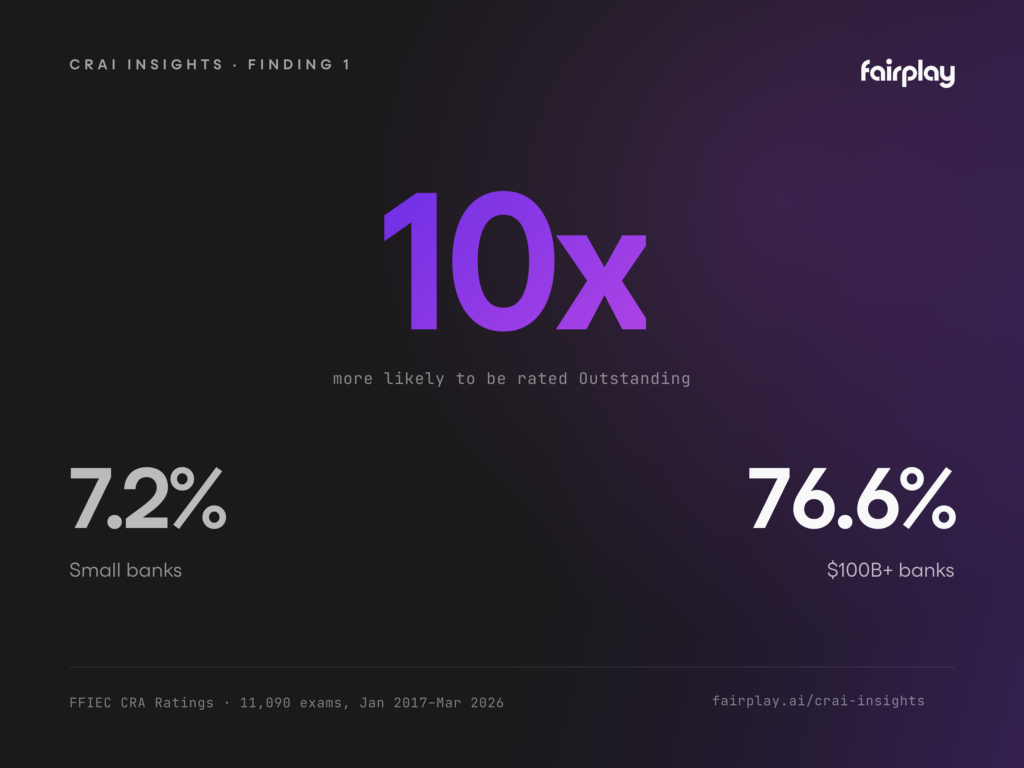
If you’ve ever compared your bank’s CRA rating to a much larger institution’s and felt the comparison didn’t sit right, the data backs up that instinct. Across 11,090 exams conducted between January 2017 and March 2026, roughly 7% of exams at the smallest banks earned an Outstanding rating. At banks with more than $100 billion in assets, about 77% did.
Small banks: 7.2% rated Outstanding → $100B+ banks: 76.6% rated Outstanding
That’s not a modest edge. It’s a rating environment where size alone predicts most of the outcome, long before anyone looks at loans, investments, or services. The relationship isn’t linear, either. In fact, it accelerates. Banks between $25B and $100B post an Outstanding rate near 39%; cross into $100B+ and it roughly doubles again. Something changes qualitatively, not just quantitatively, once a bank reaches that scale.
Two forces are doing the work
The first is capacity. Large banks have more ways to source and execute CRA-qualifying activity. A $200 billion institution may run a dedicated Community Development division with specialists in tax credits, municipal finance, CDFI relationships, and foundation giving. A $2 billion bank may have one CRA Officer wearing all of those hats, and simply cannot originate and document qualifying activity at the same pace. It’s not for lack of will, but for lack of headcount.
The second is incentive. An Outstanding rating is worth more to a large bank. It can smooth regulatory approval for mergers, branch expansion, and other strategic moves, and it functions as a hedge against fair lending scrutiny. For a community bank with no acquisition on the horizon, the marginal return on chasing Outstanding may not clear the cost of the additional CRA infrastructure it would take to get there. That’s not a failure of effort. It may be a rational allocation of a smaller institution’s resources.
What this means for your exam prep
The practical takeaway is about benchmarking, not blame. A CRA rating is only meaningful when read against exams at banks of similar size and exam type. If your board is asking why you’re not tracking with a money-center bank’s Outstanding rating, the honest answer is that you’re not playing on the same exam, even though the rating scale looks identical on paper.
- Build your peer set from banks in your own size tier and exam category (Small, Intermediate Small, or Large), not from headline-grabbing institutions several tiers up.
- When presenting results internally, frame the Outstanding rate for your tier alongside your own performance: a 32% rate at $10–25B banks is a very different bar than a 77% rate at $100B+ banks.
- If Outstanding is a genuine strategic goal, size the investment to the goal: dedicated CD capacity tends to track with the banks that reach it.
None of this means smaller banks can’t reach Outstanding. Many are able to achieve it. It means the rating alone doesn’t tell your board, your examiners, or your community partners much until it’s placed next to the right peer group.
This is the first in a four-part series unpacking the CRAi Insights Report. Next: why community development becomes the deciding factor as banks get bigger.
Source: FFIEC CRA Ratings, 11,090 exams Jan 2017-Mar 2026. Small and Intermediate Small (ISB) banks classified by exam method; large banks split by assets at exam date. Small = under $412M; ISB = $412M-$1.6B. Strategic-Plan and Wholesale/Limited-Purpose banks (distinct exam models) are excluded from the size comparison. From FairPlay’s CRAi Insights Report, Volume One (fairplay.ai/crai-insights).