
Across 8,230 exams matched to Call Report data, Outstanding- and Satisfactory-rated banks look nearly identical on capital, lending, and cash. The real difference may be in what gets credited, not what gets spent.
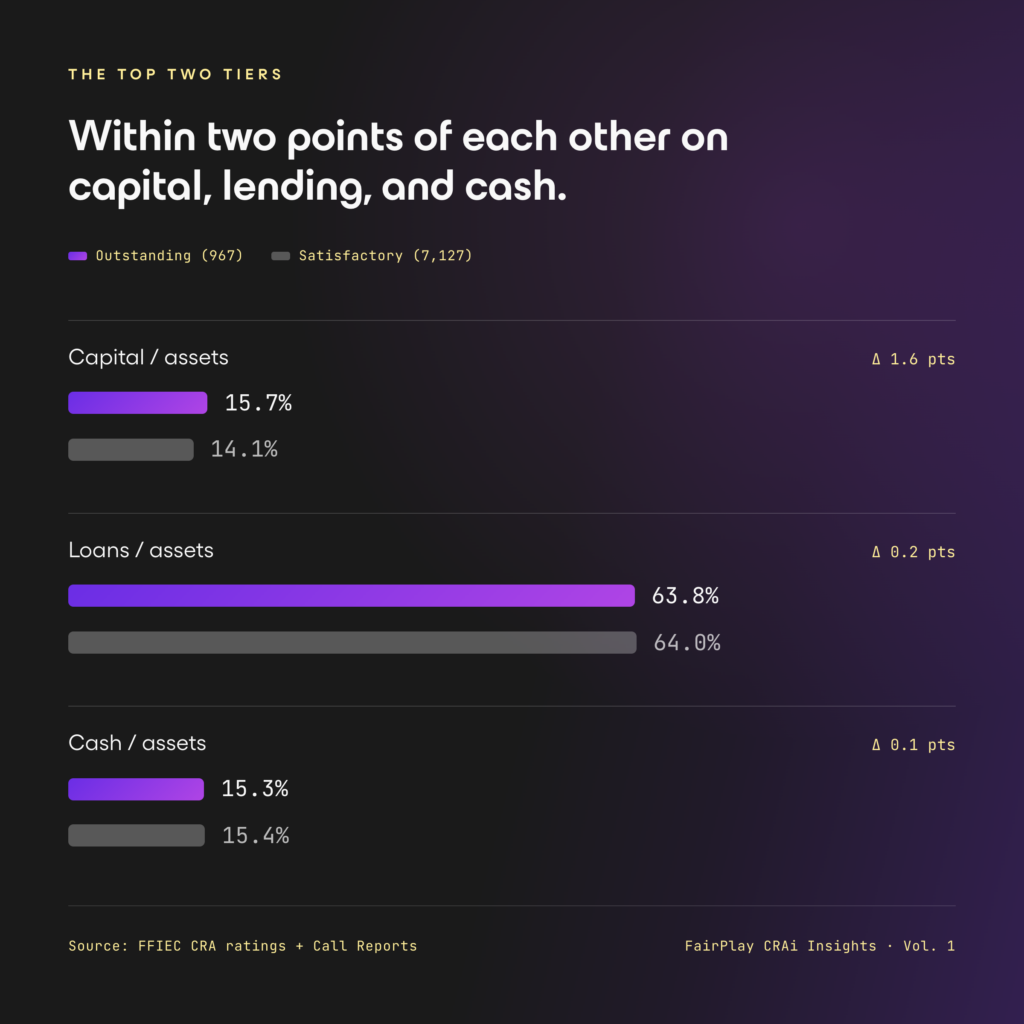
FairPlay matched 8,230 CRA exams conducted since 2017 to each bank’s year-end financial data and compared capital, lending, and cash ratios across the rating scale. The result is among the most surprising findings in the report: Outstanding banks do not appear to deploy materially more capital than Satisfactory banks.
Outstanding vs. Satisfactory
- capital: 15.7% vs. 14.1%
- loans/assets: 63.8% vs. 64.0%
- cash/assets: 15.3% vs. 15.4%
Those are near-identical balance sheets, within two points on every measure. If capital availability drove CRA outcomes, you’d expect Outstanding banks to be running noticeably fuller balance sheets in the direction of lending or investment. They aren’t.
The Needs-to-Improve comparison tells a different story
Where the data does show separation is at the bottom of the scale. Needs-to-Improve banks hold meaningfully more capital, make fewer loans as a share of assets, and keep more cash than Satisfactory banks.
Needs to Improve vs. Satisfactory
- capital: 22.5% vs. 14.1%
- loans/assets: 59.2% vs. 64.0%
- cash/assets: 18.6% vs. 15.4%
That’s a real gap, with roughly eight points of capital, five points of loans-to-assets, three points of cash. But the report also flags that this shows association rather than causation, and the Needs-to-Improve sample is thin: only 133 exams, against 7,127 Satisfactory and 967 Outstanding. Some of that capital cushion may reflect supervisors requiring it of weaker-performing banks, rather than a CRA-specific choice. While this comparison should be viewed as directional, not conclusive, it’s still noteworthy.
| Related: New Research: CRAi Insights. What 80,000 exams reveal about reaching Outstanding. See the findings →
If capital isn’t the differentiator, what is?
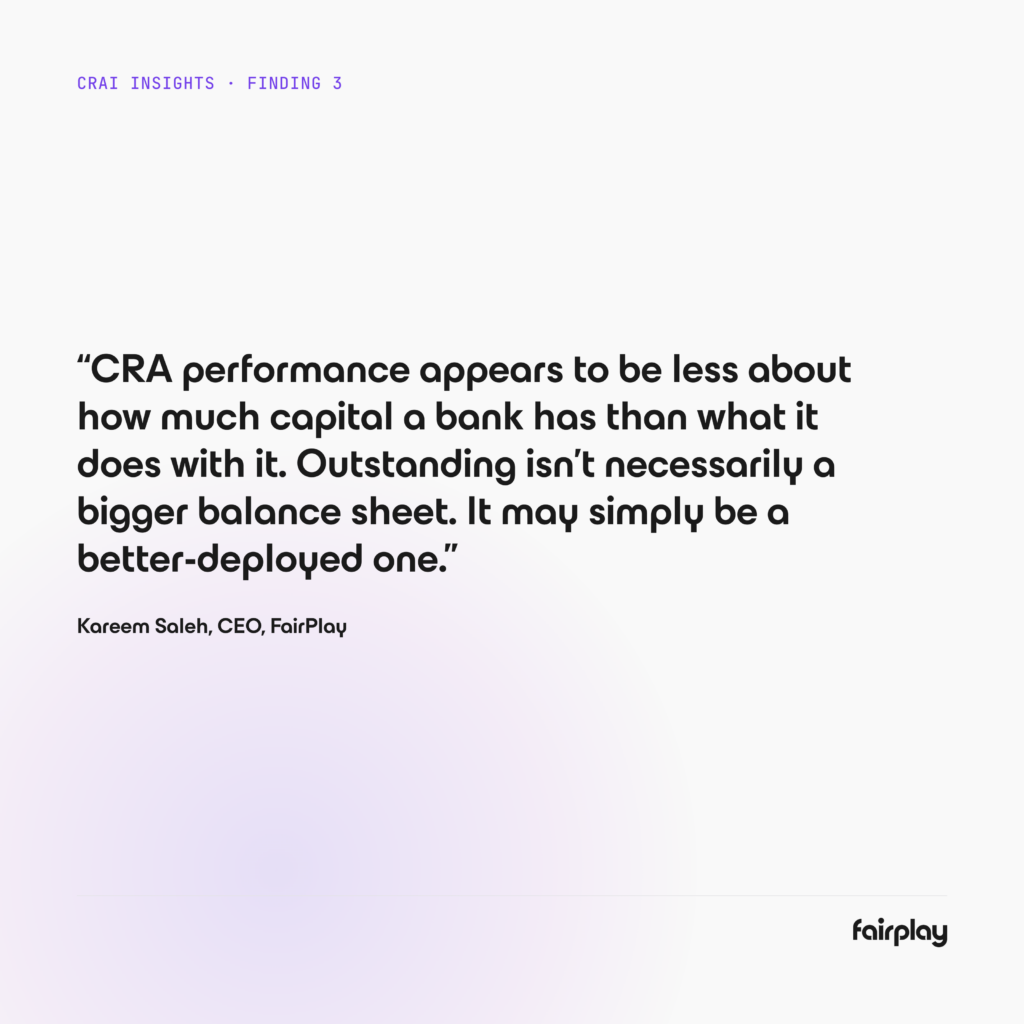
Outstanding banks aren’t deploying more capital; they’re deploying the same capital more intentionally in three specific ways:
- Choosing CRA-creditable investments. A municipal bond and a LIHTC investment can sit in the same place on a balance sheet, but only one may meaningfully advance a CRA rating. The choice of instrument matters more than the size of the position.
- Defining assessment areas strategically. Banks are evaluated where they choose to operate. A well-designed assessment area increases the odds that qualifying activity a bank is already doing actually gets counted.
- Capturing credit for work already underway. A loan to a nonprofit health clinic or an affordable-housing developer may qualify for CRA consideration, but only if it’s properly identified and documented at the time it’s made. The activity may already exist. The exam credit may not.
| Related: Read FairPlay CEO Kareem Saleh’s post on Finding 3
What this means for your CRA program
Before asking finance for more capital to throw at community development, audit whether existing capital is being routed to creditable instruments and properly tagged for exam purposes. A dollar in a CRA-qualifying investment and a dollar in a look-alike but non-qualifying instrument have identical balance sheet impact and completely different exam impact.
Given how close Outstanding and Satisfactory banks look on paper, documentation and instrument selection (not budget) may be the highest-leverage place to focus.
Previous posts:
Finding 1: Why Large Banks Achieve Outstanding CRA Ratings 10x More Often Than Small Banks
Finding 2: The Secret to an Outstanding CRA Rating
Next in this series: Why lower-income lending gaps vary so widely by geography, and why a Los Angeles bank shouldn’t benchmark against one in Des Moines.
Source: FFIEC CRA ratings joined to bank Call Reports, 8,230 exams published 2017–2026. 133 Needs-to-Improve exams, 7,127 Satisfactory exams, 967 Outstanding exams; group averages. From FairPlay’s CRAi Insights Report, Volume One (fairplay.ai/crai-insights).