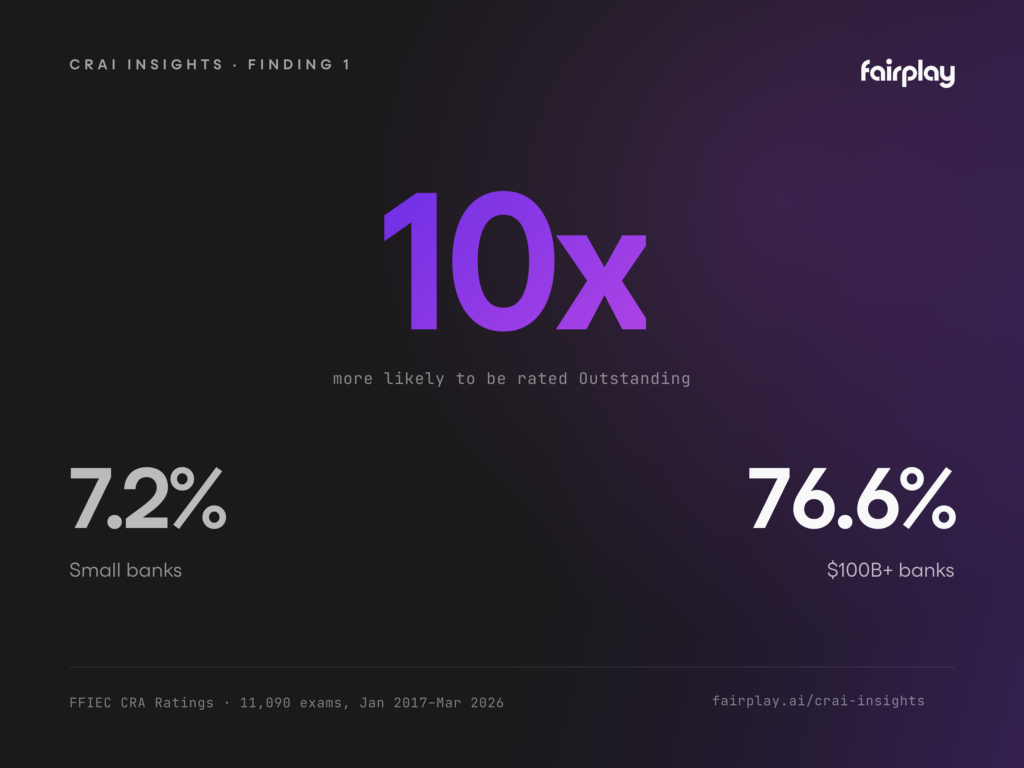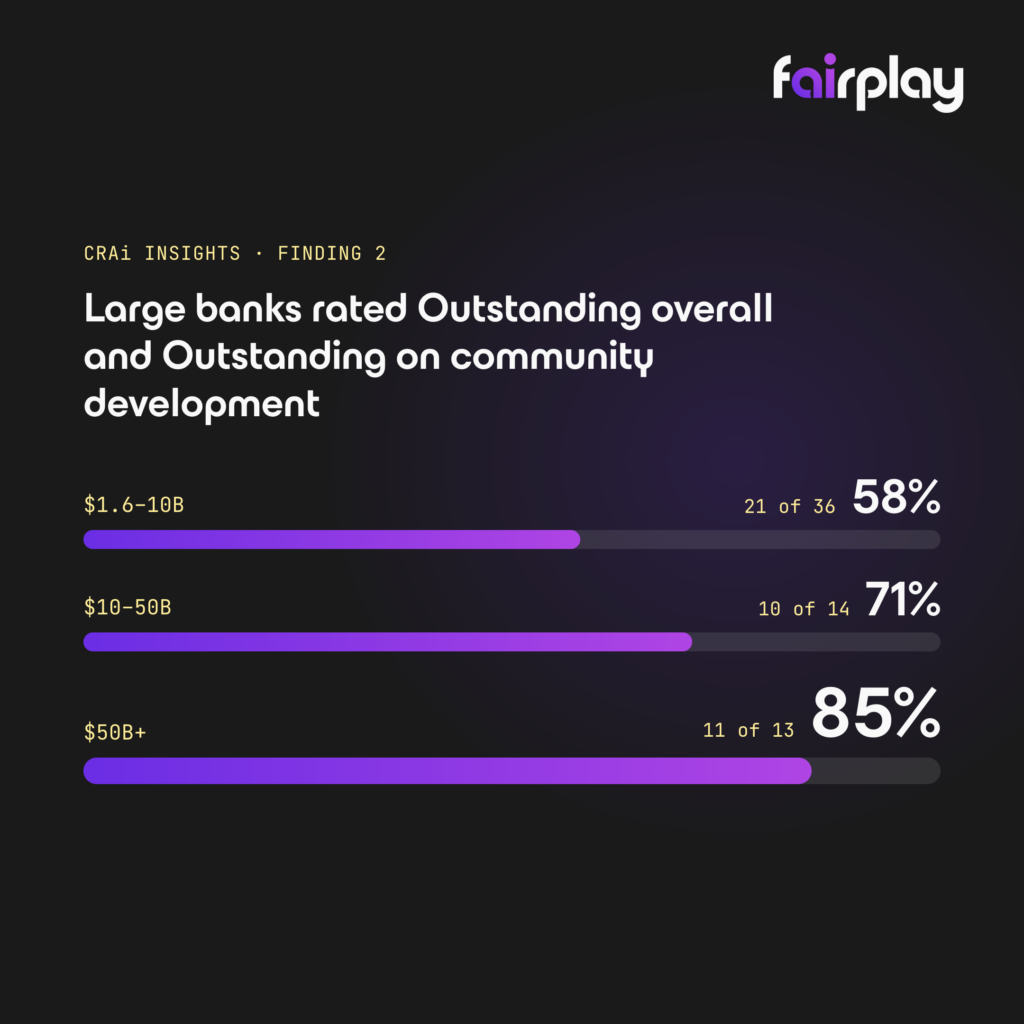
Among $50B+ banks that earned an overall Outstanding rating, 85% also scored Outstanding on the Investment Test. At $1.6–10B banks, it’s 58%. Here’s why the lending test stops being the differentiator as banks scale.
FairPlay recently studied every bank that earned an overall Outstanding CRA rating and asked: how many of them also earned the top score on the Investment Test, which measures community-development investments?
The answer correlates to bank size.
The Results:
- $1.6–10B: 58% (21 of 36)
- $10–50B: 71% (10 of 14)
- $50B+: 85% (11 of 13)
Put another way: At the largest banks, community development is nearly a prerequisite for an Outstanding CRA rating. Eleven of 13 banks over $50B that earned an Outstanding overall rating also earned an Outstanding community-development score. Among $1.6–10B banks, just 21 of 36 did.
Retail lending is a market. Community development is a choice.
The difference isn’t that large banks care more about community development. It’s that retail lending performance is heavily shaped by the market a bank operates in: local demand, housing supply, interest rates, and the credit profile of available borrowers. Banks serving the same assessment area are often competing for the same pool of customers, which limits how much their lending-test results can differ.
Related: We analyzed 80,000+ CRA exam records across more than 35 years. Here’s what we found.
Community development doesn’t have that ceiling. A bank chooses which affordable housing projects to finance, which CDFIs to support, which tax-credit deals to underwrite, and which community partnerships to build. Two banks in the same market can look identical on mortgage lending and completely different on community development, because the second measures a management decision rather than a market condition.
If lending performance tends to cluster around Satisfactory for banks operating in the same market—and our data suggests it does—then community development becomes the clearest way to differentiate. Larger banks appear to use that lever more effectively, likely because they have the specialized staff, expertise, and deal flow to build stronger community-development programs.
What this means for your Community Development (CD) strategy
There are a few implications here as you’re continuing to evolve your Community Development Strategy:
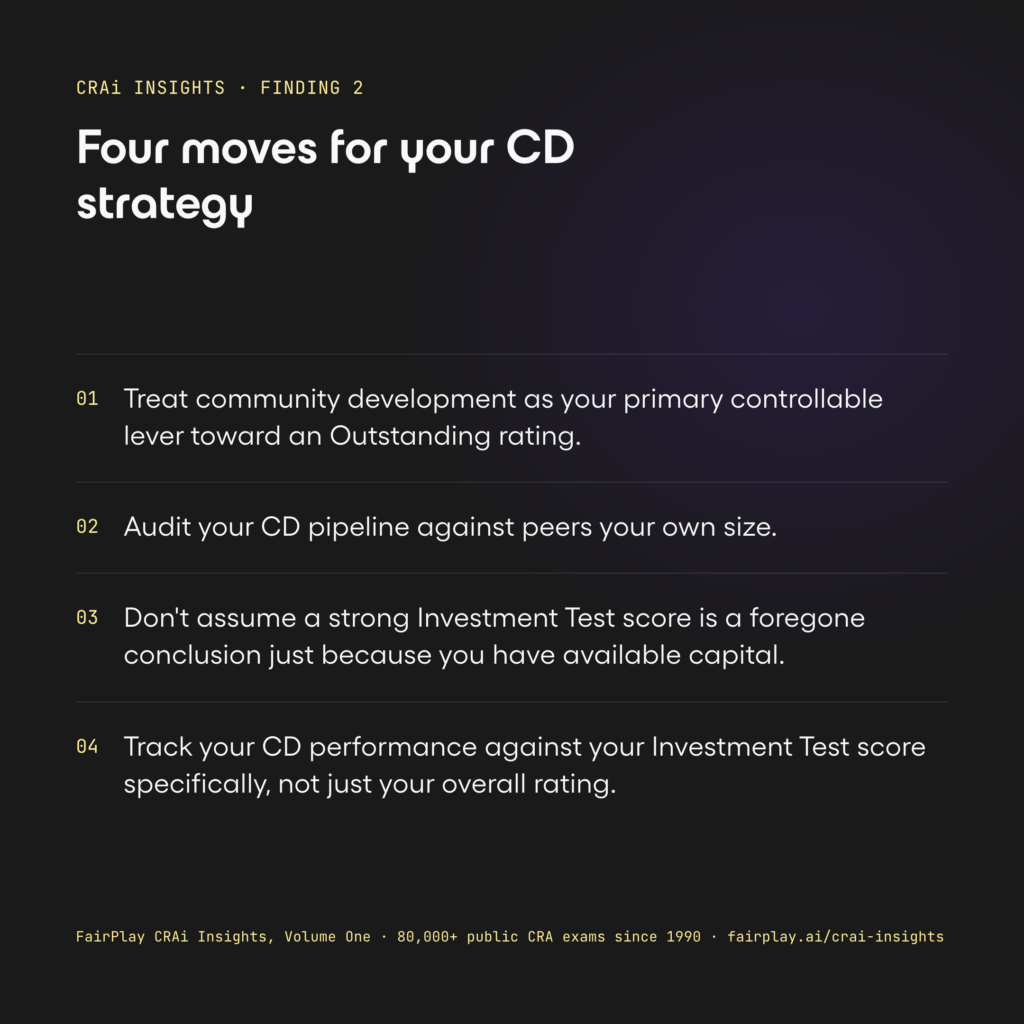
- If your lending test performance is capped by your market, don’t wait for lending numbers to move the needle. Treat community development as your primary controllable lever toward an Outstanding rating.
- Audit your CD pipeline against peers your own size. The gap between $1.6–10B and $50B+ banks isn’t just capital, it’s deal sourcing, tax-credit expertise, and CDFI relationships that take time to build.
- Don’t assume a strong Investment Test score is a foregone conclusion just because you have available capital. It requires deliberately identifying and structuring CRA-qualifying deals, not simply investing more.
- Track your CD performance against your Investment Test score specifically, not just your overall rating. That component is where the largest banks are pulling away.
For CRA officers, the takeaway is simple: if you want to move from Satisfactory to Outstanding, community development is likely your best lever. Lending can only move so far when the market sets the ceiling.
Next in this series: why Outstanding banks don’t actually hold more capital than Satisfactory ones, and what that tells you about how credit gets captured.
Source: FFIEC CRA performance evaluations and component scores, verified against underlying performance-evaluation documents. Counts reflect banks rated Outstanding overall, grouped by asset size. From FairPlay’s CRAi Insights Report, Volume One (fairplay.ai/crai-insights).