A bank analyst recently made a provocative observation: Artificial intelligence transformation may actually be easier for smaller banks to pull off than larger ones.
At first, that sounds backwards.
The biggest banks have enormous technology budgets. They employ armies of engineers and data scientists. They have more data, more sophisticated infrastructure, and more money to invest in AI.
Surely they should win.
Maybe.
But the analyst’s point wasn’t about who can build the most sophisticated AI.
It was about who can actually transform their institution around it.
And there, smaller banks may have some surprising advantages.
| Related: The Three Layers of AI Agent Correctness
Small banks have less to unwind with AI
Consider what it takes to introduce a new AI workflow at a global bank.
The technology may need to connect to dozens of systems built at different times, on different architectures, across different business lines.
The data may live in multiple warehouses.
The workflow may have accumulated years of exceptions, controls, handoffs and workarounds.
Then there is the organization surrounding it.
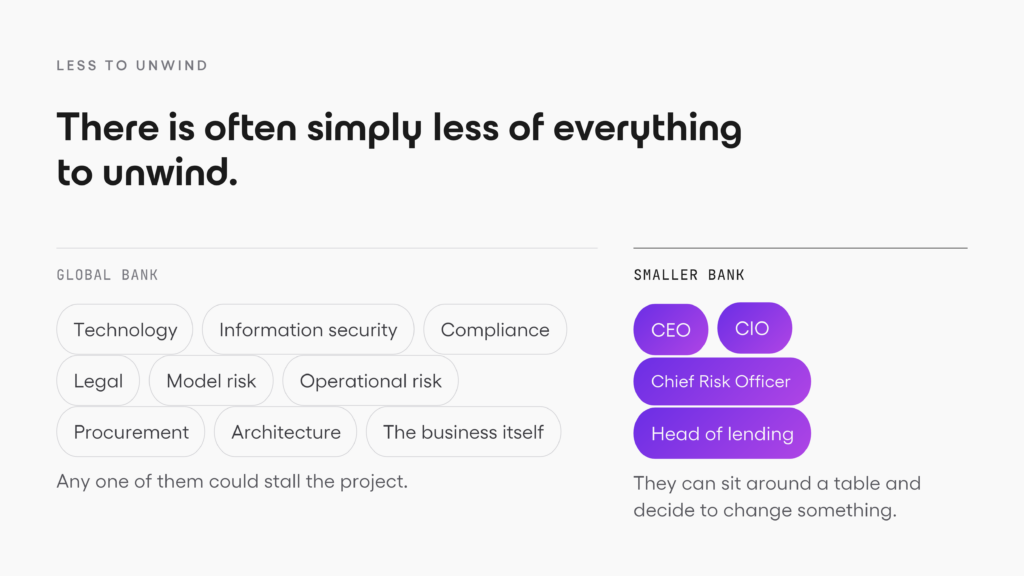
Technology. Information security. Compliance. Legal. Model risk. Operational risk. Procurement. Architecture. The business itself.
All of them may have legitimate concerns. Any one of them may be able to slow the project down.
A smaller bank can have plenty of legacy technology too.
But there is often simply less of everything to unwind.
Fewer systems. Fewer business lines. Fewer organizational layers. Fewer committees. Fewer people whose jobs and budgets are tied to the existing process.
And perhaps most importantly, fewer dependencies between decision-making and implementation.
The CEO of a Tier 1 bank can certainly get the heads of technology, risk and lending around a table. But even if they agree on a course of action, executing it may require coordinating hundreds of teams, navigating dozens of interconnected systems and redesigning processes that span multiple business lines.
At a smaller bank, the distance between a strategic decision and operational change may be much shorter.
That’s the advantage. Not better leadership or faster decisions, necessarily.
Fewer obstacles to turning decisions into action.
Smaller banks don’t have to build the AI.
This is where the argument gets more interesting.
For most of the history of banking technology, scale conferred an enormous advantage.
A Tier 1 bank could spend billions building capabilities that a $10 billion bank could never afford.
AI may change some of those economics because intelligence can increasingly be bought.
A smaller bank doesn’t need to build its own foundation model.
It may not need to build its own underwriting agent, KYC agent, servicing agent, collections agent or compliance agent either.
Specialized vendors can build those capabilities once and sell them to hundreds of institutions.
That creates the possibility of technological leapfrogging.
The smaller bank doesn’t have to recreate the technology organization of a megabank.
It can buy the capability and focus on putting it to work.
That suggests an important distinction:
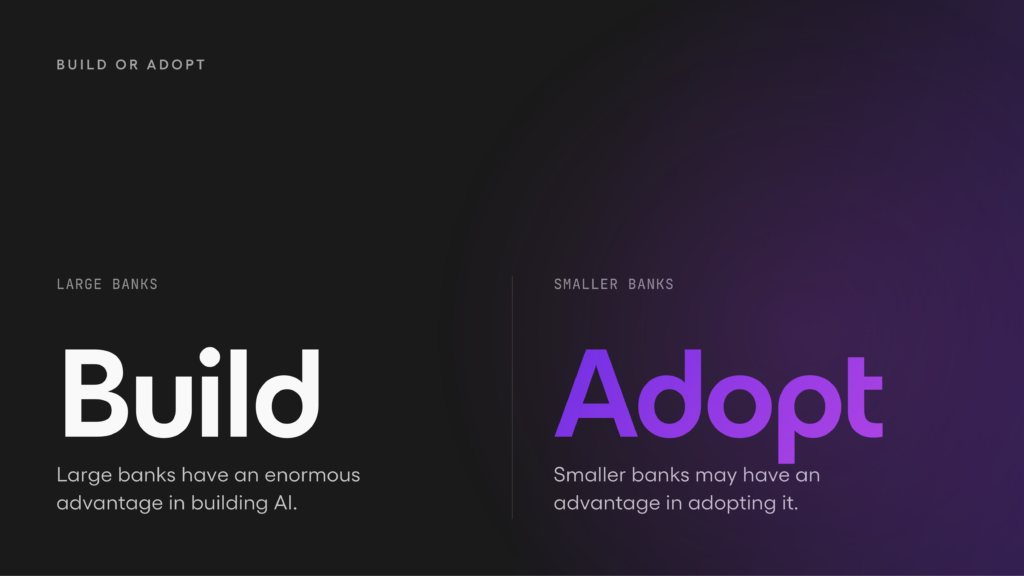
Large banks have an enormous advantage in building AI. Smaller banks may have an advantage in adopting it.
AI use in banking could change the economics of scale.
There is an even bigger possibility.
Banks have historically benefited from scale partly because the fixed costs of running a regulated financial institution are enormous.
Technology. Operations. Compliance. Risk. Customer service. Underwriting. Fraud. Collections.
A large bank can spread those costs across millions of customers.
But imagine a smaller bank that can use AI agents to dramatically increase the productivity of those functions.
It might be able to double or triple in size without doubling or tripling its operating infrastructure.
That doesn’t eliminate the advantages of scale.
But it could reduce some of them.
AI could allow smaller institutions to acquire capabilities that once required enormous internal organizations.
In that sense, AI isn’t merely another technology investment.
It could change what an efficient bank looks like.
Mid-size banks may have the toughest path to AI adoption
There is an interesting corollary.
The institutions with the hardest AI transformation problem may not be the smallest banks.
They may be the banks in the middle.
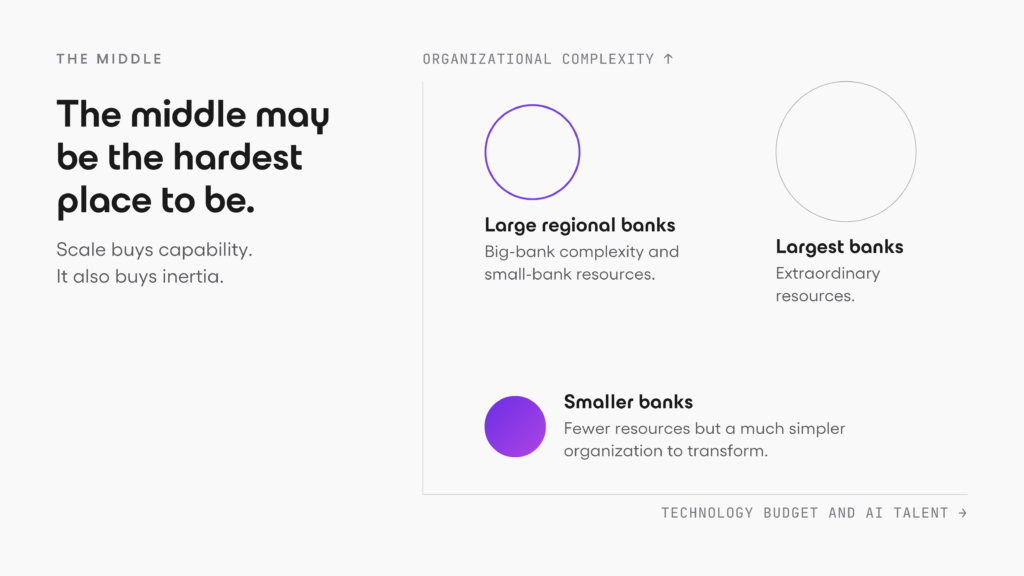
Large regional banks can have much of the complexity of the largest institutions: multiple systems, accumulated acquisitions, organizational silos, elaborate governance processes and thousands of employees.
But they don’t necessarily have the technology budgets or AI talent of JPMorgan, Capital One or Goldman Sachs.
They can end up with big-bank complexity and small-bank resources.
Meanwhile, a smaller institution may have fewer resources but a much simpler organization to transform.
Scale buys capability.
It also buys inertia.
AI in Banking: Here’s The Catch
None of this means smaller banks automatically win.
Their advantages come with serious disadvantages.
They have smaller technology teams. Less AI expertise. Less proprietary data. Smaller budgets.
And their dependence on vendors cuts both ways.
If your core provider moves slowly, you move slowly.
More importantly, smaller banks generally don’t have armies of model validators, AI governance specialists, compliance professionals and engineers available to evaluate every new AI system.
That may become one of the central challenges of AI adoption in banking.
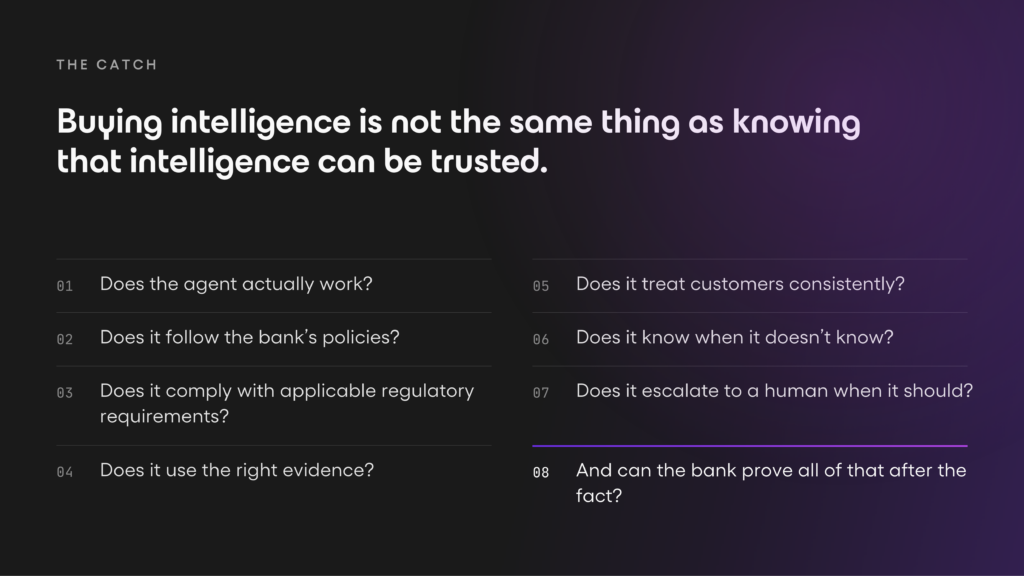
Because buying intelligence is not the same thing as knowing that intelligence can be trusted.
A bank still has to answer some basic questions.
- Does the agent actually work?
- Does it follow the bank’s policies?
- Does it comply with applicable regulatory requirements?
- Does it use the right evidence?
- Does it treat customers consistently?
- Does it know when it doesn’t know?
- Does it escalate to a human when it should?
- And can the bank prove all of that after the fact?
Those questions become especially important when the institution didn’t build the AI itself.
The next banking technology race may look different.
The conventional assumption is that AI will widen the gap between the biggest banks and everyone else.
It might.
The largest banks have extraordinary resources, and they are investing aggressively.
But there is another possibility.
AI may make sophisticated capabilities dramatically cheaper to acquire while making organizational adaptability increasingly valuable.
If that happens, the winners won’t necessarily be the banks with the most engineers.
They may be the institutions that can identify the right technology, establish that it is safe to use, and reorganize themselves around it fastest.
That creates an intriguing possibility for smaller banks.
For once, having less machinery may be an advantage.
The biggest banks have more resources to build the future.
Smaller banks may have less standing in the way of becoming it.