Introduction and overview
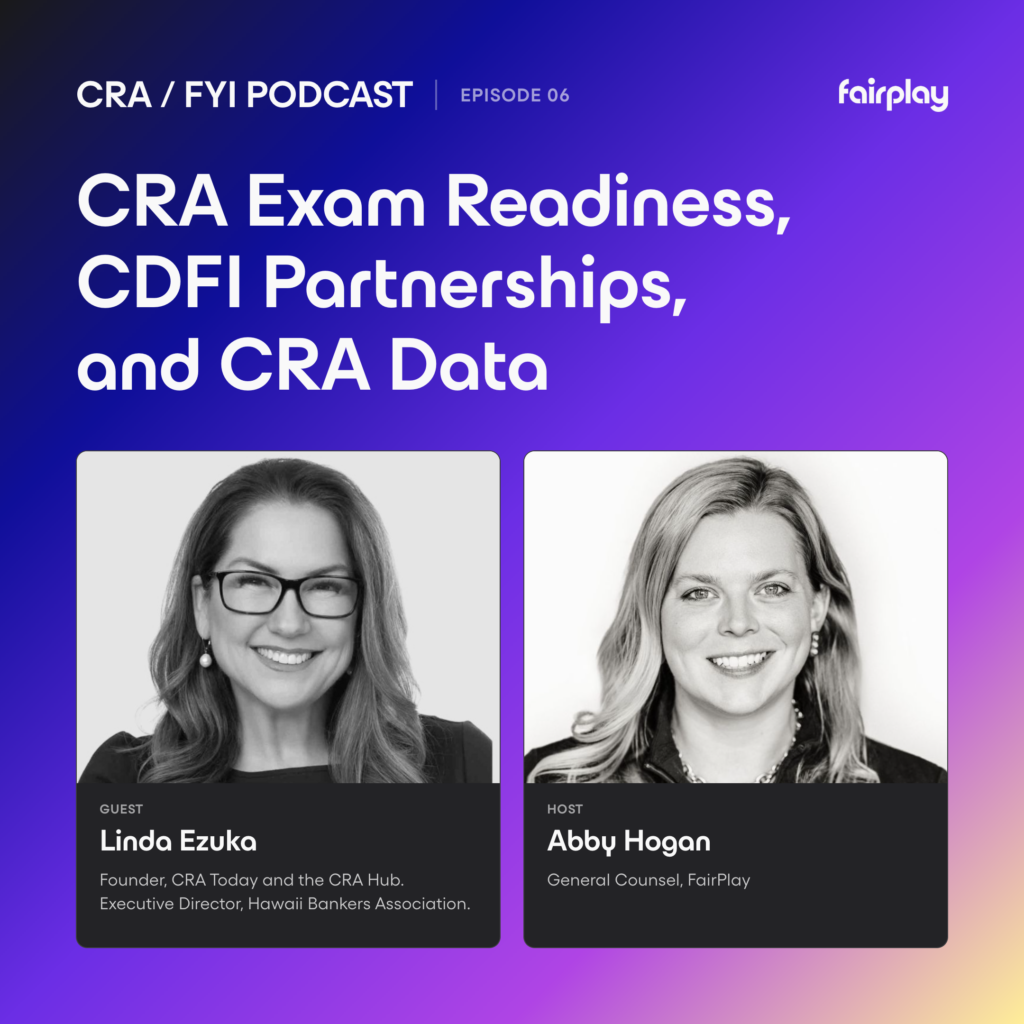
On the sixth installment of CRA / FYI, FairPlay’s podcast on the Community Reinvestment Act (CRA), FairPlay general counsel Abby Hogan talks with Linda Ezuka, founder of CRA Today and the CRA Hub and executive director of the Hawaii Bankers Association. Ezuka details her 32-year career in community development, from Bank of Hawaii in the early 1990s to consulting for community development financial institutions (CDFIs) and launching CRA Today in 2019.
The conversation focuses on the proposed CRA changes that the Office of the Comptroller of the Currency (OCC) and the Federal Deposit Insurance Corporation (FDIC) issued on July 31, 2026, without the Federal Reserve. Ezuka advises CRA officers to prepare for their next exam under the current rule rather than build programs around a proposal. She explains her concern about different CRA rules at different agencies, her comment letters arguing that clearer guidance under the 1995 rule could meet the proposal’s goals, and why she thinks benchmarks would limit the performance context banks can give examiners. She and Hogan also discuss how cutting reporting requirements would leave banks collecting the same data while losing peer comparisons, and how faster release of small business and small farm data would help banks correct course sooner.
Watch the full episode:
Time stamps:
00:00 Introduction: Linda Ezuka of CRA Today and the Hawaii Bankers Association
03:03 From Bank of Hawaii to CRA Today: 32 years in community development
04:58 How Linda found her way into banking and CRA compliance
07:03 Advising CRA officers while the rule is in flux
10:20 Two CRA impact stories: a CDFI investment and a youth farm land loan
17:10 Banks, regulators, and advocates: shared goals, different approaches
18:03 What Linda is watching: a split between the agencies and the midterms
20:25 Linda’s comment letters: why she says the CRA is not broken
24:00 The examiner’s side: outdated guidance and newer examiners
26:05 Benchmarks versus performance context
29:40 CRA data: the same collection work with less peer data
34:02 Faster data releases as low-hanging fruit
35:10 What the CRA conversation is missing
36:00 Congressional role in CRA
38:20 Closing
Full transcript:
Abby Hogan (00:00): Hello and welcome to FairPlay’s CRA podcast, where we discuss all things Community Reinvestment Act. This week, we’re incredibly lucky to be joined by Linda Ezuka. Linda is the founder of CRA Today and the CRA Hub, an exclusive membership for bank professionals to master the art of the CRA, get exam ready, and leverage capital for the greater good.
Ms. Ezuka also leads the Hawaii Bankers Association as its executive director. Linda hosts the CRA Podcast, a podcast to elevate conversations around the Community Reinvestment Act, and has over 32 years of community development experience with emphasis on CRA compliance, CRA on-site and remote training, community development finance, CDFI investments, and partnerships. She has led CRA programs for large banks and has consulted with banks of all sizes and regulators.
Ms. Ezuka currently serves on the board and the investment committee of the HMSA Foundation, the advisory board of the Patsy T. Mink Center for Business and Leadership, and as a strategic advisor for the Hawaii Community Reinvestment Corporation. She was previously chairwoman for the board for the YWCA of Oahu, Hospice Hawaii, and HCRC. She has also served on various nonprofit boards, focusing her leadership efforts on serving CDFIs and disadvantaged communities. She is a CDFI, NMTC, and CDFI reader, a Pacific Century Fellow, an SBA Financial Services Advocate of the Year awardee, and a Pacific Business News 40 under 40 honoree. Linda is the author of the book Outstanding: A Practitioner’s Guide to Exam Readiness. Wow, that’s a really incredible resume.
Linda Ezuka: Well, that’s a mouthful. I should have gave you the shorter version.
Abby Hogan: It is such an honor to have you here on the podcast with us and to get to hear more about your experience and kind of all of the expertise you bring to this area. So thank you so much for joining us today.
Linda Ezuka: Thank you, Abby, for the opportunity. It’s so nice to talk CRA with somebody that gets it. There’s very few of us in the world. Most of what I know and my experiences have really been through working within a bank and then with bankers and working with CDFIs and nonprofits and really in the trenches and helping bankers drive impact into disadvantaged communities. So it’s really my pleasure to be here and to share what I know and what I think and where I hope we’re going really with community development in the future, because that’s what’s most important.
Abby Hogan: Could not agree more. I guess let’s start from the beginning. How long have you been in this kind of ecosystem? How long have you been advising folks or working on CRA issues?
From Bank of Hawaii to CRA Today: 32 years in community development
Linda Ezuka (03:03): Well, I started at Bank of Hawaii in the early nineties, and that was pre-internet. I know, I know. Yeah, back in the paper and binder days, I tell you. I spent twelve years there, and then I transitioned to be the chief operating officer for a nonprofit that was $25 million in annual revenue. So I was running that organization really on the community side, because I fell in love with community development and nonprofits. And then I transitioned, once I had my children, into consulting. And so got to work with CDFIs, raise capital for CDFIs, serve on boards, was a grant reviewer for the Department of Treasury CDFI Fund, and got to work with banks running their CRA programs.
And in 2019 I wanted to shift my focus, and so I had a great vision for CRA Today. So that was 2019, I launched that, and now I spend my time in training. It’s really my priority and it’s my passion. I love helping bankers comply with the CRA, but more importantly, drive impact by leveraging that capital for the greater good. So I’m so honored to do this work and really fell in love with it way back then, and so thrilled to be able to help others with their leadership opportunity. Really, I see it: a lot of people come to me for compliance, but my secret game is to help them comply but then to drive impact, because that’s what I’m going for. So that’s a long way around it. But yeah, over 32 years in it and just so honored to do the work.
How Linda found her way into banking and CRA compliance
Abby Hogan (04:58): It’s incredible when you can find that intersection of passion area and the thing that you’re good at and wanna do, and the thing that kind of brings you a lot of joy and that helps others. And sounds like you’ve really, really found it here.
Linda Ezuka: Yes, it does. Absolutely.
Abby Hogan: So a lot of us didn’t know we were gonna end up in banking from the start. And if someone came into your school and asked ten-year-old Linda, what did you wanna be when you grow up? What would you have told them then? And how did you find yourself kind of coming into banking?
Linda Ezuka: Well, I had no idea. I think many of us find ourselves somehow within a bank, and then, if we’re lucky enough, to be part of a CRA program. So I used to work out at four thirty AM every morning at a gym, and I met this woman that worked at a bank, and I was newly graduated, and so she would talk to me and just said, would you be interested? We have an open position. And it was in marketing at a bank and running the charitable foundation. And it was a really cool job, especially when you’re so young and starting out your professional life.
I really say that I grew up professionally there, because I got the opportunity to meet with nonprofits and go through all the training, and then I had the great privilege to meet my mentor in community development, who found me in marketing and stole me away into compliance. So that’s how it all happened. The rest is history. I’ll share more a little bit later, but I was pretty lucky to have met my mentor, who’s still a dear friend today.
Abby Hogan: What an incredible story. I feel like almost everyone working in banking has a parallel story of none of us thought we would end up here. But, I don’t know, it feels like a very welcoming or rewarding kind of career path. We find the people that make this job really, really worth doing day to day. So it’s incredible background for you.
Linda Ezuka: Absolutely.
Advising CRA officers while the rule is in flux
Abby Hogan (07:03): Let’s pivot just a moment and talk through, kind of back to the CRA. If we’re thinking through the notice of proposed rulemaking, the comment period is now closed, and we’re kind of waiting for all the dust to settle to see what comes out in a final rule. Can you talk us through how you’ve been thinking about or advising clients with the potential rule changes?
Linda Ezuka: My gosh, well, first I say here we go again.
Our community has been through it over 10, 12 years. I can’t keep track, but with the 2023 rule, the litigation, the pending rescission, and now new proposal, a possible bifurcated system, it’s all exhausting. It’s exhausting. And so I encourage everybody to take a deep breath, right? And to just say, no matter what happens, we’ll figure this out together. I think that’s most important. We get, we’re tired. We have a lot of work. And when I say the royal we, this is really about the CRA practitioners that I serve, right? That show up every day and are focusing on their CRA programs and driving impact.
So I always encourage people to focus on the things that we can control, right? The rules seemingly are proposed to change a lot, right? And the most important thing, though, is everyone has their next exam coming up with the current rule. And I haven’t met an officer yet that has extra time on their hands, right? And so I help them certainly be aware and to learn about the proposals and to consider their views and their thoughts and to give feedback into industry groups, right? So their voice can be heard. But then they have to focus on the next thing, right? They need to focus on the board and committee reports and cleaning and scrubbing their data, and most importantly is driving impact.
And that’s a lot to carry. It’s just a lot right now for them. So it’s something that we’re all really trying to balance, trying to understand where we’re at and really prepping for the next exam.
Abby Hogan: That makes sense. The CRA officers are sitting at this really fascinating intersection, right? Where they’re trying to get investment dollars from their leadership at the bank. They’re trying to do right by the communities they’re serving. They’re trying to comply with these relatively complex regulations, work with outside partners. It’s not an easy role, to be sure.
Linda Ezuka: It is not.
Two CRA impact stories: a CDFI investment and a youth farm land loan
Abby Hogan (10:20): So I guess thinking through practically what it means to do CRA work. I mean, at the end of the day, everyone in this ecosystem is working on trying to get dollars into the communities that really need them and trying to serve underserved areas. At least that’s how I view CRA at the end of the day. Do you have any stories you could share with us, whether it’s your approach or specific anecdotes, about the impact you’ve been able to see banks make in communities with these dollars?
Linda Ezuka: Sure. I have two stories. The first one is a Hub member of mine that came to me more towards the beginning, like a founding member. And this was five, six years ago. And she was brand new to banking and brand new to the CRA. And so she’s been in my community for a while, and what I care deeply about is that our CRA professionals can learn the tools that the very large institutions use, like partnering with CDFIs. And I try to make it really accessible and share how we create our first relationship with the CDFI and what that looks like and what that brings and what impact you can forge in very simple ways, like a first call to outreach to a CDFI, to serving on a board, to volunteering, to make a grant, to actually moving through and doing something more difficult, like placing an equity-like investment.
And I’m so proud to say that over time this banker, then she was an ISB and then grew to a large, she not only learned the CRA, she created a CRA committee, then she forged a partnership with a CDFI, and then she made an equity-like investment in a CDFI. Now, this is an ISB that moved to a large, so a community bank. And I couldn’t be more proud, because that’s community development. That is one person that learned the tools, that saw her place in leadership, and then drove impact. That’s what gets me up every day, right? I mean, that is what’s exciting. That is what this work should be, right? That is leveraging capital for the greater good. So that’s one story.
The next story is when I was working with a client, and there was a group of young children that were in school, like high schoolers, and there was a nonprofit farming operation, and they wanted to acquire more land so that they can do more training for the students that were all low income. And they would garden. So it was more like garden-to-table work. They’d raise and propagate kale. And it was an amazing success story, because these young adults in a high school were learning farming, they were learning responsibility, came from low-income families, and they were given a job, right? And this nonprofit wanted to buy more land. Well, making a land loan is very difficult for financial institutions, because there’s no cash flow yet. There’s a promise for cash flow in the future.
And so we were pulling together the external stakeholders. There was a philanthropic foundation that was interested in supporting the project, or that was at the table. There was the nonprofit, there were banks, and it was an undoable deal. I mean, at its face, right? Hard to do a land deal. It was a nonprofit with not a lot of assets, but with a great vision and great output. And so the bank and the foundation got together, and we had conversations around how could this work? And so we were able to bring a guarantee from the foundation into the bank that enabled the bank to make the undoable deal doable. And I’m just so proud to say that that nonprofit is thriving and that land was put to work, right? And they’re driving impact and changing young adults’ minds and also producing income, right?
And so anyway, it was just a great success story. And it’s the power of partnership, and it’s the power of bringing stakeholders together for the greater good. And we’re not talking enough about that type of work now. And we’re stuck in proposed rules and rescissions and all of the other things that are important from a policy standpoint, but I really want to stay anchored in the important work that’s before us. So, two stories. I rambled, but those are two stories that are important to me and that are illustrative of the possibilities.
Abby Hogan: Those are incredible stories, Linda. I think I didn’t truly understand the depth of your work in the kind of coaching, right? That impact of taking a banker at a bank that previously didn’t have the connections or, I don’t know, the training to be able to make the kinds of investments like those, and then connecting them with the knowledge and the resources and the right folks to really kind of level up the types of investments they could make that are just gonna make real day-to-day changes in a lot of people’s lives. It’s incredible work.
Linda Ezuka: It’s the best work. And it’s the opportunity to lead, right? And to really make a difference. And that’s what I’m in for.
Banks, regulators, and advocates: shared goals, different approaches
Abby Hogan (17:10): Well, how do we follow that? Everything else seems so small in comparison to when you look at the real impact this type of work has. Then these proposed rulemakings and the nitty-gritty of which box you’re checking, it all seems relatively insubstantial, right?
Linda Ezuka: Well, it’s all important, right? We have folks that are focused on policy, and we need those voices, and we need the intent, and there’s a lot at stake, right? And so there’s a lot of different opinions about what community development is and what is not. And everybody has a right to their view, right? And that’s what’s so challenging: we have our banks, we have our regulators, and we have our community and our advocacy groups. And I really think that we all care about very similar things, but we have different ways of going about it. But that’s what makes our community so special. Not so easy, but special.
Abby Hogan: Yeah, never easy when you’re trying to take the opinions of lots of different informed minds and kind of put them together.
Linda Ezuka: I know, that’s right.
What Linda is watching: a split between the agencies and the midterms
Abby Hogan (18:03): So I guess kind of returning to this idea of how do we get from point A to point B, right? We know the point B is we want to get money into communities and help folks. But the point A is we have the current rule, we have the proposal. In terms of looking at where we are right now, or kind of the proposal in front of us, do you have any thoughts, whether on the proposal itself, or if you had the pen on the rule, other changes you would make in that position? I don’t know if you submitted any comments on the rule. Basically, any feedback you have on the current kind of proposed rule.
Linda Ezuka: Sure. Well, I’m not gonna predict where this is going. And honestly, nobody really knows, right? And I have no private information or intel. So I’ll tell you what I’m watching. I’m concerned about a bifurcated process, right? If the OCC and the FDIC go about this differently than the Fed. I mean, there’s enough confusion around what the CRA is and is not. There’s very few experts across the nation that understand CRA. And I think it’s really important that we, like everyone else, approach the CRA from an interagency basis. And so join the crowd, right? We’re all looking for that.
In fact, I just had somebody in my community say, wait a minute, I referenced that illustrative list, can’t I use that? And I was like, no, no, no. That was from the OCC, and that’s not valid anymore. It was valid for a short period of time, and it’s still creating regulatory confusion, right? So we’ve been through a lot lately, and so that is what happens when we are not on an interagency basis, so that is very concerning.
And then of course we had the midterm, right? And so now the proposed rule with the FDIC and OCC, that proposal came out of a deregulation push or intent, right? To reduce the burden on banks as its intent, things might swing the other way and we’re not sure. There’s just so much that can happen, and this is where our officers get so concerned. And this is where our officers get so concerned, right? That, I don’t know where to focus. And so again, I have them focus on their next exam, right? To not build any program around any proposal, because we’ve seen it shift too many times, right?
Linda’s comment letters: why she says the CRA is not broken
Linda Ezuka (20:25): And so it was important to engage and to share our opinion. And our industry leadership does great. Our trade organizations do an amazing job at representing the voices of our industry. But at the end of the day, our practitioners are again working on the fundamentals, right? And really focusing on the next thing. So I think that, of course, remains really, really important.
Yeah, I did submit two comment letters, and I have a lot to say about the proposed rules, and I took two positions. I did two, I don’t know, I probably could have just done one. But the first one that I submitted was really kind of stating that the CRA is not broken. The intent of the proposed rules, as I understand it, was to really create simplicity, to increase clarity, right? And I think that could have been achieved or can be achieved today with the current rule.
We have very outdated resources, right? We have a Q&A from 2016 that we still rely upon, and that is not even broad enough to cover all of the scenarios that we encounter. I learned something new from our bankers every single week, and I’ve been doing this for 32 years. We have new products, new borrowers, new scenarios that we’re trying to figure out. [It] is the most subjective compliance regulation out there, because we get to be reasonably certain that it meets the primary purpose of community development.
So I love the concept of an illustrative list. And that can be done today. It doesn’t require a new rule, right? And we could clarify the sticking points, because most of our officers have a long list of those sticking points, right? And those that live this daily have a whole host of things that we could clarify so that we can move forward together. And the more we restrict and change the regulation, the more our financial institutions will lose their autonomy to truly meet the unique credit needs of a community. Right now, in the 1995 version, it’s not perfect. But the financial institutions have that ability to uniquely serve the credit needs of their communities in the ways that they deem appropriate. And then we put performance context and share the story of impact from there. I know I kind of went all over the place there, but I have a lot to say. I mean, there’s a lot of elements that I think that we can shore up under the current rule that would achieve the same purpose. So I can keep going.
The examiner’s side: outdated guidance and newer examiners
Abby Hogan (24:00): No, I think that’s very helpful. I don’t know, when you’re a regulator, it seems so simple, right? When you’re in there, you’re like, well, we’ve given them everything they need to know, and we think these parameters are helpful. And at least for me, I was a regulator for nearly a decade before going in-house in banking and fintech orgs. And it wasn’t until that moment that I realized, like, dear Lord, [this] is not helpful. The thing I need is not in here. And you’re going there saying, okay, well, I know this is how exams went, or you’re going off of other anecdotal evidence rather than being able to point to, okay, here’s the guidance, or here’s the reg, or here’s the thing that would help me right now. And so just the ability for regulators to hear more directly from the practitioners here at the other end of the reg would be incredible.
Linda Ezuka: That’s right. And you know how it is. It’s hard to be an examiner, right? And so some people may villainize the regulators, but the reality is most of those that I’ve encountered over time, they care about this work too, right? And they want to do a good job, and they want to generally help the bank present all of the performance context and all of the activities that the bank should get credit for. In fact, I’ve heard stories where the examiners have helped those that are newer to the CRA really understand: well, during an exam, did you consider this activity or this activity? And really extended some grace, because again, to your earlier point, none of us grew up wanting to be a CRA practitioner.
And I really do think that our regulators are in it for the right reasons too. But they have some dated rules that need some modernization. We all know that. It’s not a perfect regulation, but I think that we can clarify a lot to move forward together. And there’s a whole host of new folks that are newer to regulating, right? And to doing bank exams. So a lot of my CRA practitioners say, yeah, I got another green one. So I think that there’s a lot of training that can be done too, or more conversations. Back in the day, we used to do a lot of those roundtables, and there was a lot of outreach, and there was a lot of conversations around let’s bring everybody together and let’s show what great partnerships there are and how we can do this work together. And things have changed a little bit, of course. So yeah, I mean, there’s a lot we can do.
Benchmarks versus performance context
Abby Hogan (26:05): Yeah, the analogy: I’m much more myself a fair lending person, more recently getting very deep in CRA as well. But in fair lending land, there’s this push and this pull between, okay, we want clear, measurable, I don’t know, parameters. We want to be able to tick the boxes and know that we’re gonna come out with this rating, right? That’s on the one hand. But then once you start living that tick-the-box reality, then you’re like, well, there are all these other factors that the boxes being ticked don’t consider about the difficulty of doing X, Y, Z, or the unique financial circumstances in the areas where we operate. And can’t we take that into consideration?
And so then when you’re in that, then you’re subject to a lot more regulatory discretion and one examiner versus the other’s judgment. And so it’s that push-pull of, well, we want to be able to take into consideration all the reasons why our situation is unique or special, but also we want to be able to have a certainty to the threshold of if we do X, Y, Z, we will meet the requirements. And so I think you expressed that very well in CRA land as well. It’s that push-pull of you kind of want both.
Linda Ezuka: Yeah. Well, we have to talk about that. So there was a move in the 2023 rule to set benchmarks. And somebody went long on that intent, and it’s like, well, this’ll make it a lot more certain, and people will know exactly where they stand. But the trade-off is, well, every community is different, every bank is different. And if we try to boil it down to a benchmark, we’re constraining innovation, we’re constraining uniquely serving the credit needs of a community. And it’s pretty risky to have a benchmark out there, and then we might be artificially just trying to meet a benchmark without really understanding what are the credit needs, what’s going on in our community. I think we lose a lot when we try to benchmark in CRA.
I get both sides. Some people are gonna be like, the subjectivity of it. But the beautiful opportunity under the current regulation, the 1995 version, is that we get to say, but wait, let me tell you more. It’s not just a benchmark. No community is a benchmark, right? It’s like, let me tell you more. Yes, we are below aggregate here, but let me tell you who else is in the market, what else we’ve done, who else we partnered with, how much we care about this. There’s so much more to the story, and I’d hate for us to lose that opportunity to provide performance context. And if it’s straight on a benchmark, we lose all that. So you lose the autonomy, quite frankly. And I know we’re gonna talk about data, because I know you care a lot about it. So do you want to talk about the data as it relates to the proposed rule and what we might be losing there? I’m worried about that.
CRA data: the same collection work with less peer data
Abby Hogan (29:40): Yeah, let’s dig into it. I think there’s some pros and some cons, right? About the attempts here to reduce regulatory burden, right? So we’re trying to make this easier for the folks trying to do the right thing and get access to credit or get these investments into these communities, right? We want to make their jobs easier. But the proposed rule has this interesting kind of gotcha, where it looks like it’s being made easier because we’re reducing some of the regulatory reporting. But that’s not really reducing the need to collect the data, right? A lot of the CRA officers at the end of the day, even if they’re not required to report it, are still gonna be required to collect this. But they’re gonna lose the benefit of accessing everyone else’s data in order to do their analytics.
Linda Ezuka: Exactly. I’m most concerned about that approach and that intent, because today, current version, right, we have reporters. And while these reporters are in their exam, they have not only a data integrity exam, but then they’re being compared to aggregate. There’s not enough information on similarly situated peers. And we’re still struggling with not enough data with the current practice, with the current reporters. And then you have those on the cusp of a large bank, and they’re like, well, I’m not a reporter, I collect and maintain, and you might be comparing me to aggregate. Well, is that fair? Does that work? How would a bank, if not reporting, how would you actually self-identify and self-regulate and see how much is enough, right? And not to not have that benchmarking. I’m bringing up that word again, but not having that data at least to say, okay, that’s something to work from, right? And let me tell you more.
From a regulatory standpoint, for somebody who’s not in it day to day, they may think that that’s regulatory lift, right? And lifting the burden. But the reality that every single bank must collect and maintain this data. And they’re maintaining it and just not reporting. But the bulk of the work is collecting, extracting it from the bank, scrubbing it, right? And preparing for the exam. And the actual reporting is pushing the button, right? And every bank must have clean data and will be examined under a data integrity review to ensure that the data is sound so that they can move on to evaluate the performance. There’s really very little lift in that, because it’s pushing the button in the end. Well, that’s my opinion. And that part, I think, was the biggest risk, because not only we’re doing the same amount work, but we’re losing all of that comparison data, which is already difficult, which is not enough today.
Faster data releases as low-hanging fruit
Linda Ezuka (34:02): And then, okay, Abby, you’ll appreciate this. So you know the drill. We report what we report: small business, small farm, and then HMDA. How fast does HMDA come out? Right? It comes out…
Abby Hogan: Annually, or quarterly for large reporters. Yeah, not that often.
Linda Ezuka: Well, but the government turns it around quickly, so you actually get 2025 within a month or two. And then, yes, yes. And when do we get our small business, small farm? We just got it last week. And so we’ve lost a whole year at self-correcting, evaluating and self-correcting. And that can be changed without a new… You don’t need another rule. You don’t need a new rule. If you sped that up, that would reduce regulatory burden. That would increase clarity. That would simplify things for banks, because then we’d be able to evaluate our performance and then against aggregate and then work towards our similarly situated peers. So I don’t know. There’s just so many things that I believe is low-hanging fruit that can reduce the regulatory burden and increase certainty, which is the intent of the proposal.
Abby Hogan: Yeah, and we haven’t even touched on the new data collection requirements for the grant recipients and other… I know, there’s just so much. Yeah, a lot of opportunities.
Linda Ezuka: I know. How long do we have? I don’t know. We can go on and on and on.
What the CRA conversation is missing
Abby Hogan (35:10): So I guess we should start to probably wrap it up here. I would love to just talk with you all day. And as a fellow kind of podcast host, I’m sure, I don’t know, you’re so incredible at having these conversations already. It’s just so easy to kind of chit-chat and get lost in the conversation. But what are we not asking here in all of the conversations about the new rule, the proposed rule? What are we missing? What have you not heard folks talking about enough?
Linda Ezuka: Well, we’re hearing a lot about policy, right? And very little of what we’re hearing as of late is about what are we trying to achieve? Why are we in this work? Our bankers are in the trenches driving impact. Our advocacy groups care deeply about what’s happening in their communities. We all care about this. And it’s like, how can we come together and figure out what works? And we’ve been trying at this for quite some time. So I think we need to have more people at the table and have deeper conversations. We have these two- or four-year cycles, and then we keep switching back and forth, and we need something that’s more durable. Our bankers need more certainty, our regulators certainly need to meet their obligations. There’s just a lot around what CRA could be.
Congressional role in CRA
Linda Ezuka (36:00): And the hardest questions of all are not necessarily at the regulatory level, it’s actually at the congressional level. I mean, it was enacted in 1977 for a reason. And I believe in its mission. But we’re trying to play with the regulations when there might be a larger play, more difficult, longer conversation, but maybe a conversation that needs to be had. I don’t know. I’m gonna stick to my knitting and focus on things we can control. But there’s a lot at stake, and we all care deeply about this. So I think it’s focusing on our leadership role. What impact can we forge? What responsibility do we have? What privilege do we have in this work? To really think about how can we change people’s lives. And that’s lost. That’s lost in the swirl of so much, in my opinion.
Closing
Abby Hogan (38:20): But it’s a powerful way to go out, Linda, here: that let’s all kind of go back to basics, focus on what matters, look at our kind of northern star here, and see kind of what could we be doing differently to meet the moment.
Linda Ezuka: Yeah. Well, it’s the best work. It’s really such a privilege to do this work alongside with our bankers, and it’s my life’s work, and I hope that I get to continue to forge community development impact for so many more years, I hope, and do it together as a broader community would be my hope.
Abby Hogan: I think we’ll end right on that note. That is a hard one to follow. Thank you so much, Linda, for joining us today. It has been a privilege having you on the podcast, and we look forward to kind of future conversations together and any opportunities for further collaboration between our groups. Thank you.
Linda Ezuka: It would be my pleasure. Thanks for your time today. Take care.
Abby Hogan: Take care.